Big Chief Shaka Zulu
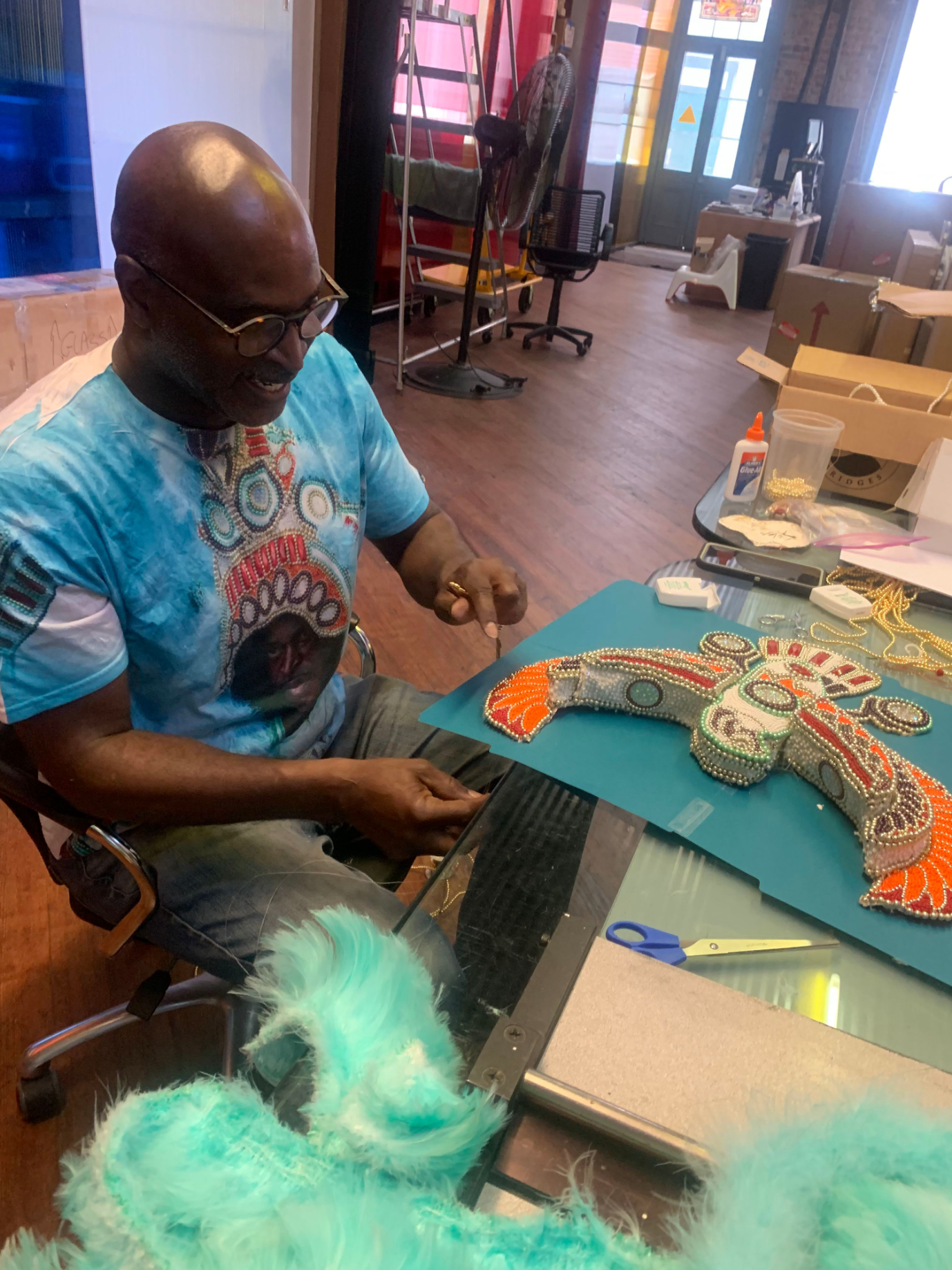
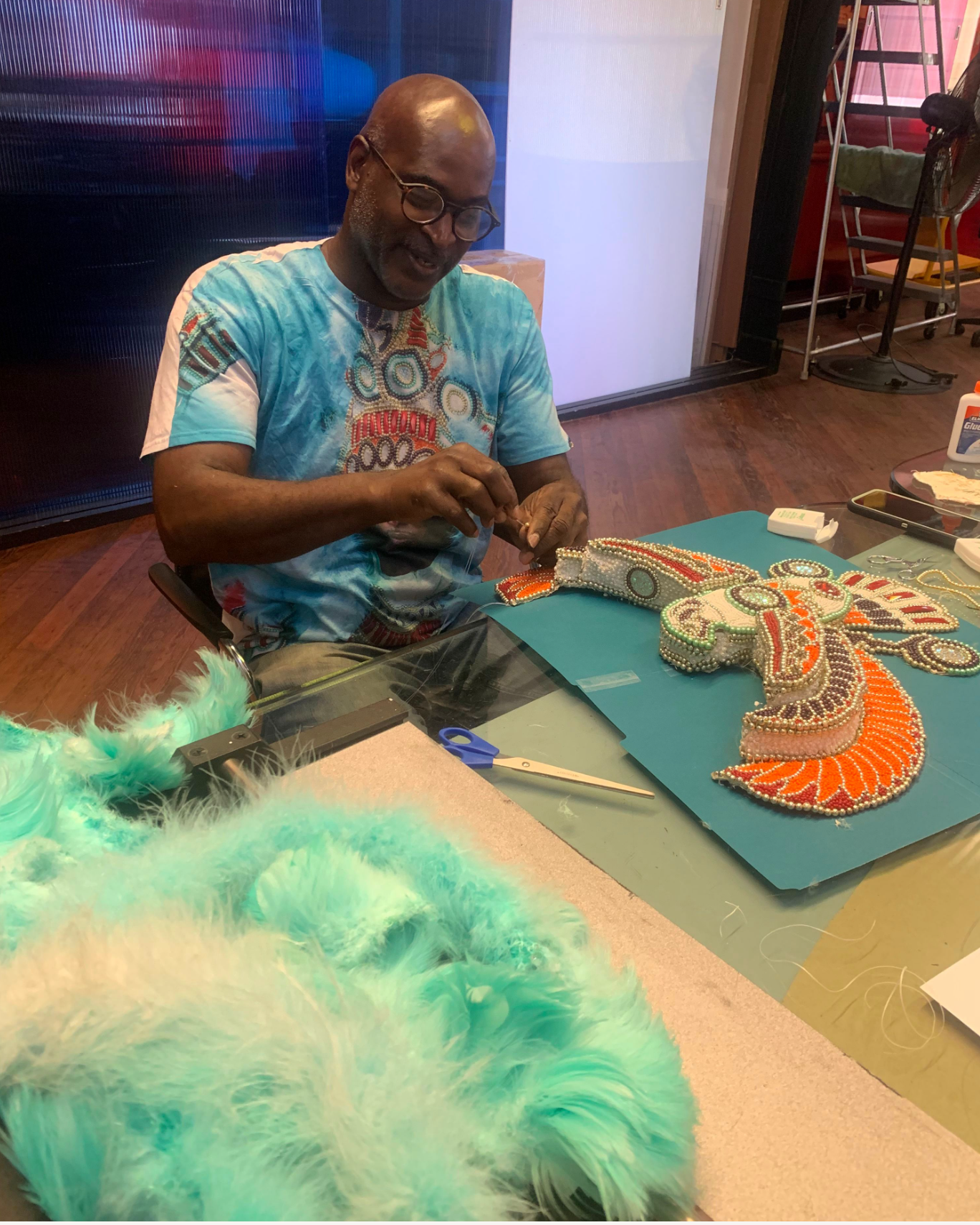
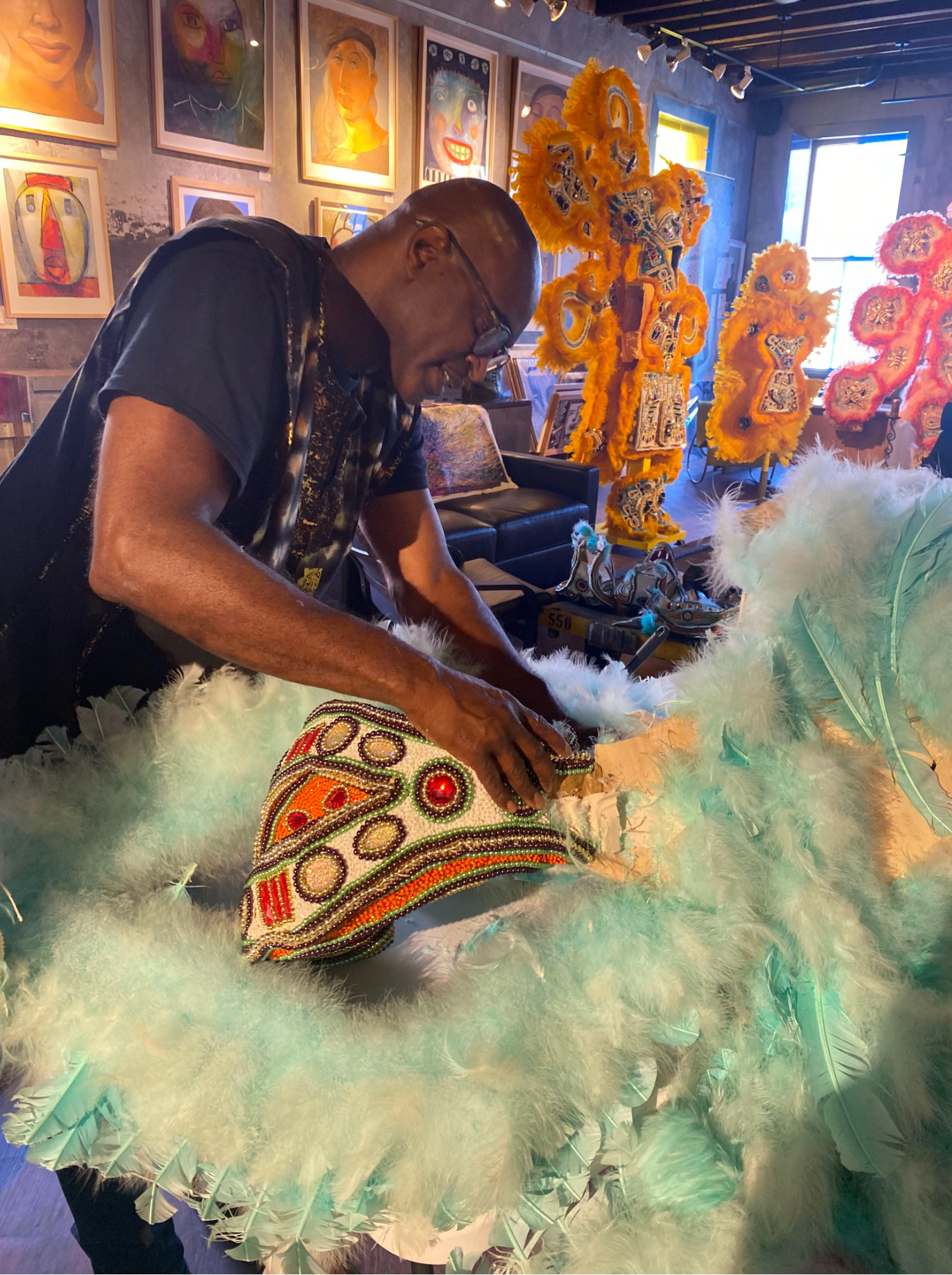
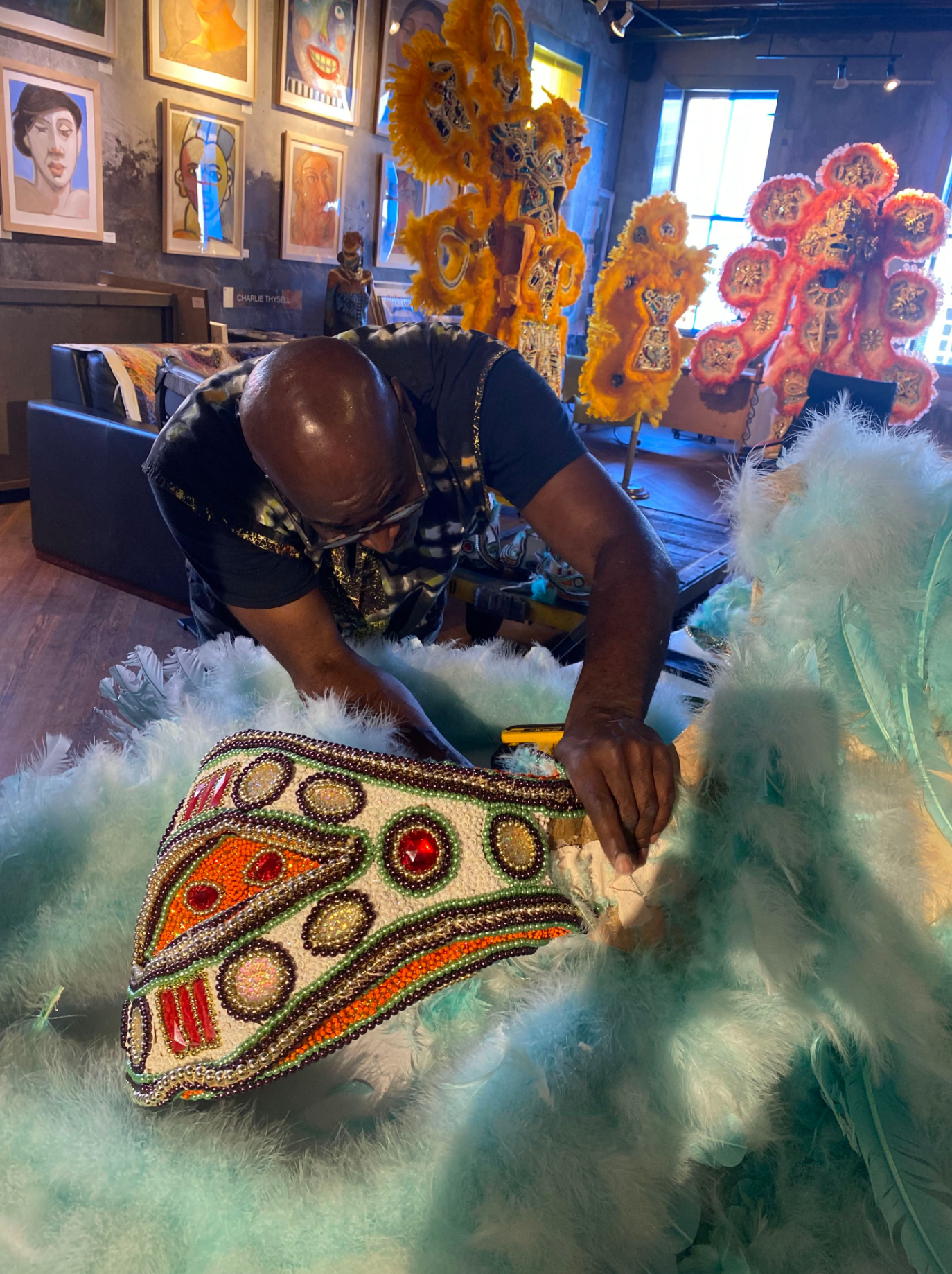
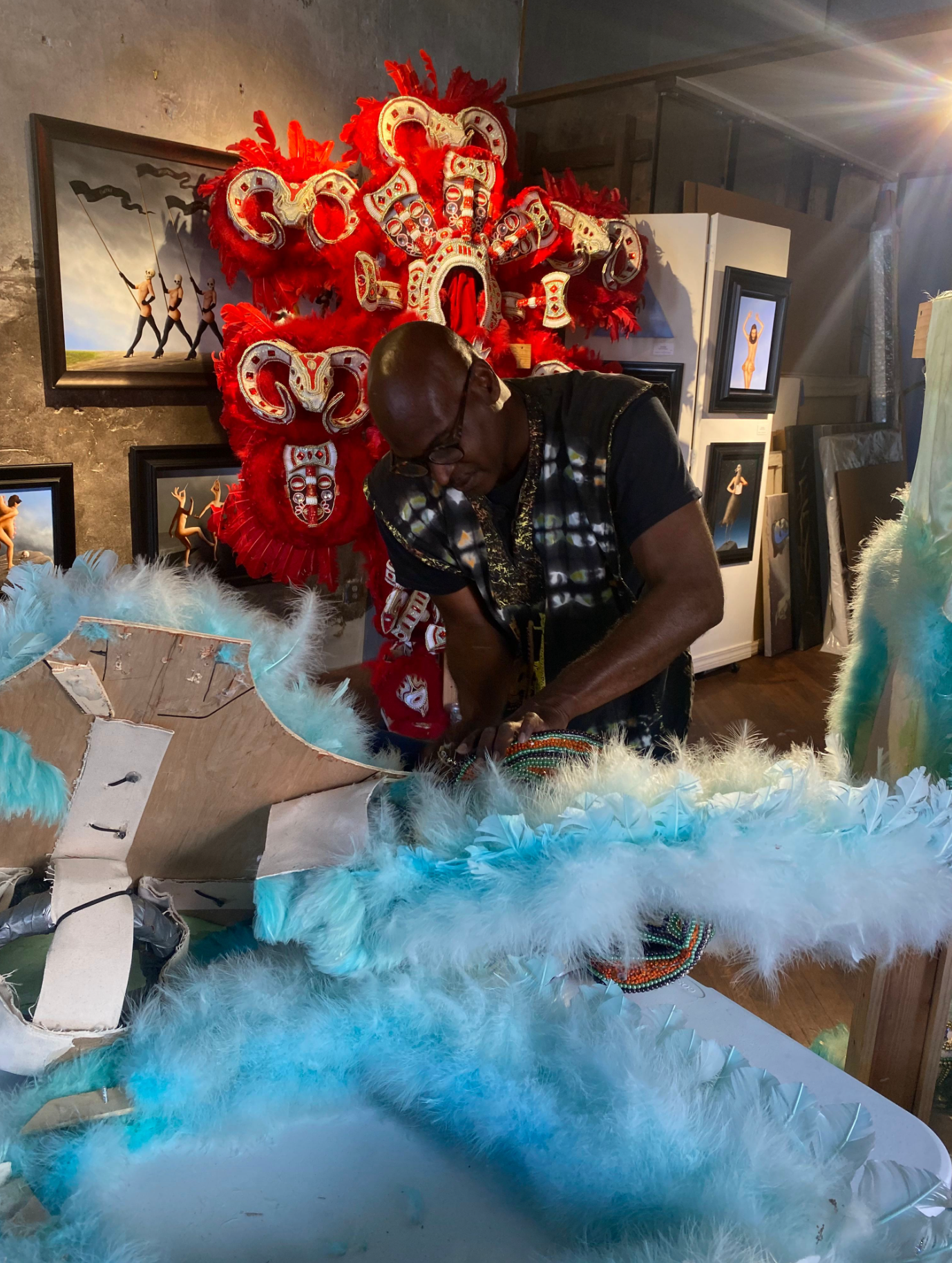
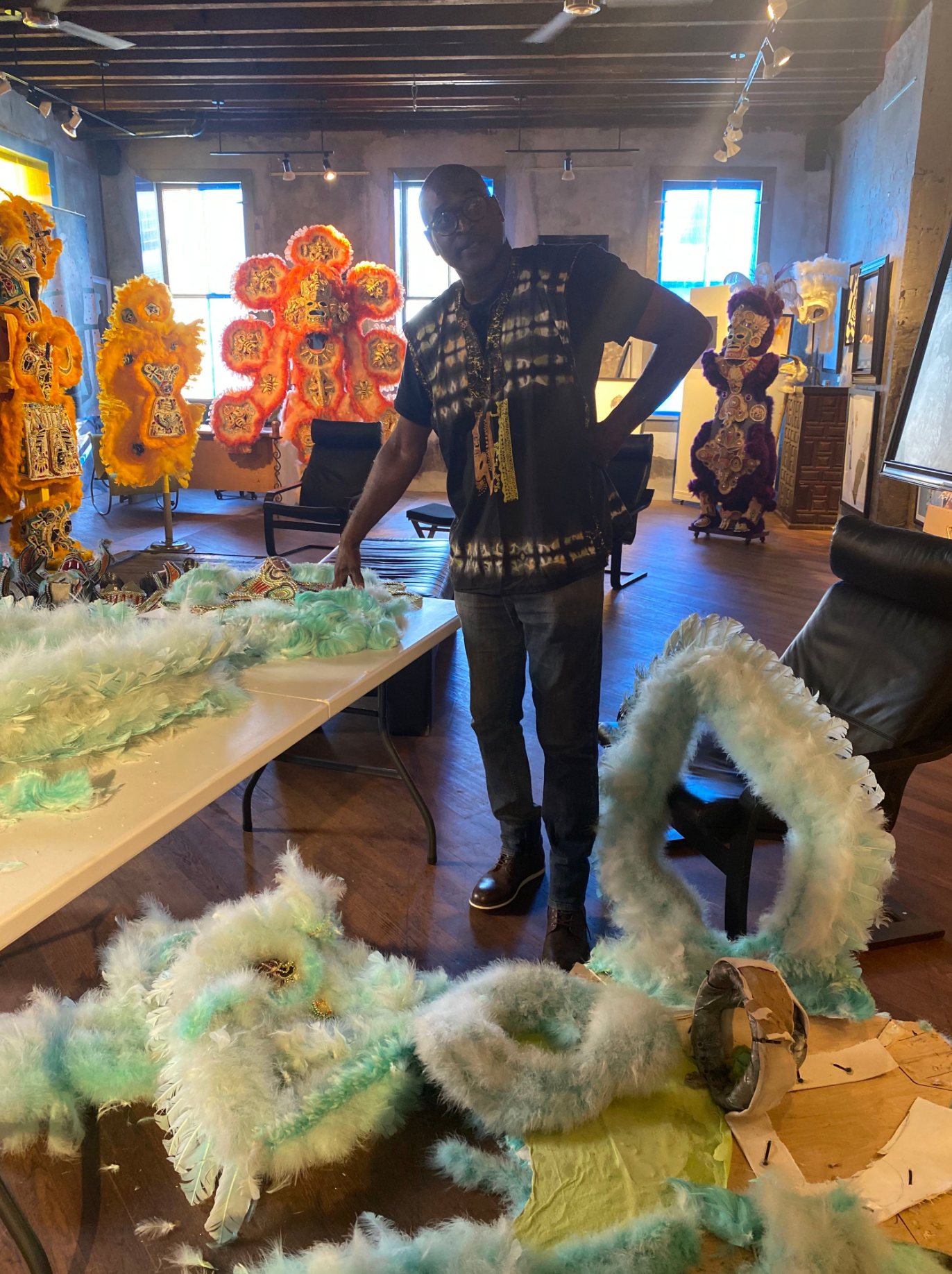
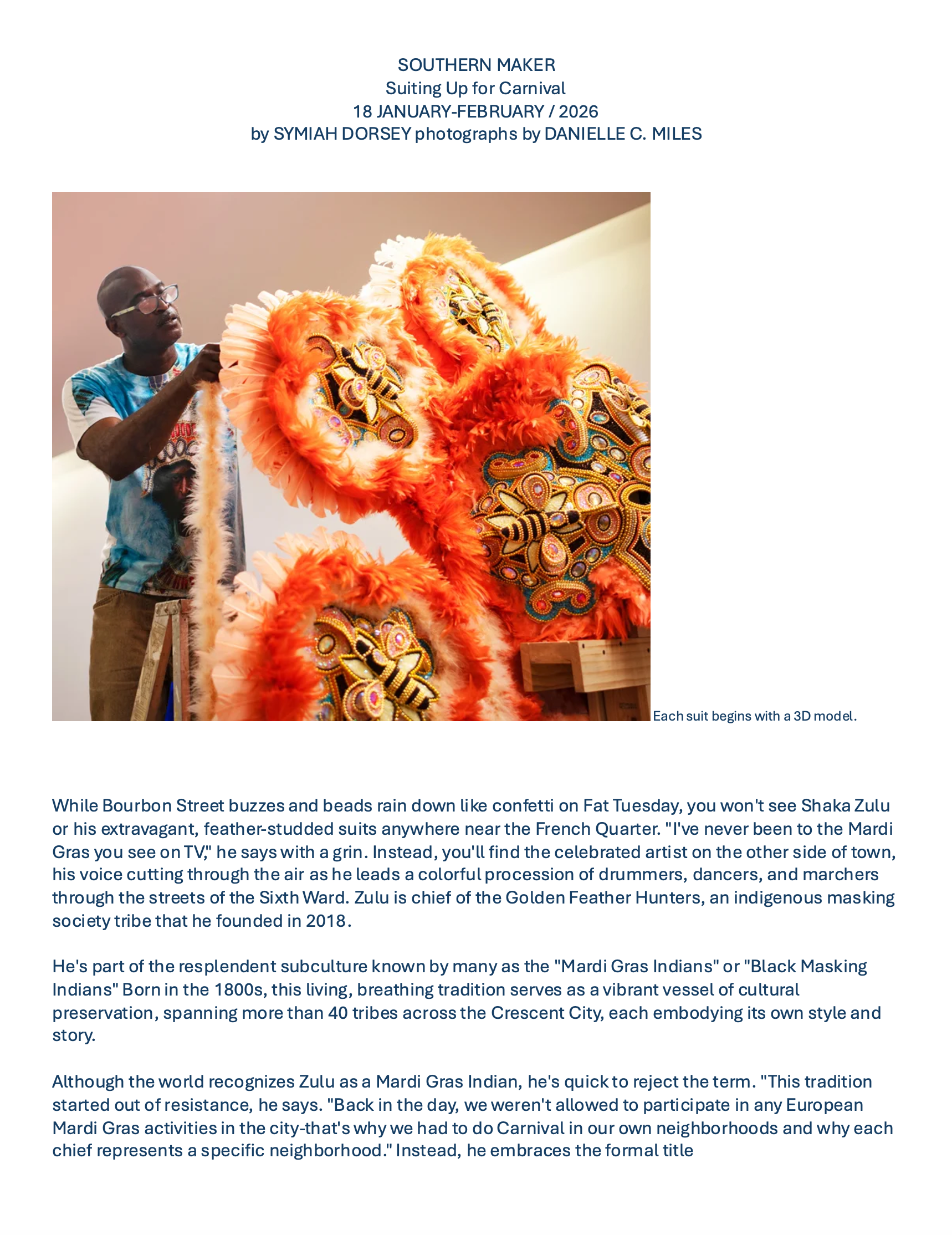
Big Chief Shaka Zulu is a master of Black Masking suit design, an art form specific to New Orleans, Louisiana, which originated as part of the Indigenous and African culture in the city. The intricate suit-building of the New Orleans Black Masking carnival tradition usually involves sewing and designing for one full year, and are colorfully displayed during Mardi Gras, St. Joseph’s Night, and Super Sunday in New Orleans.

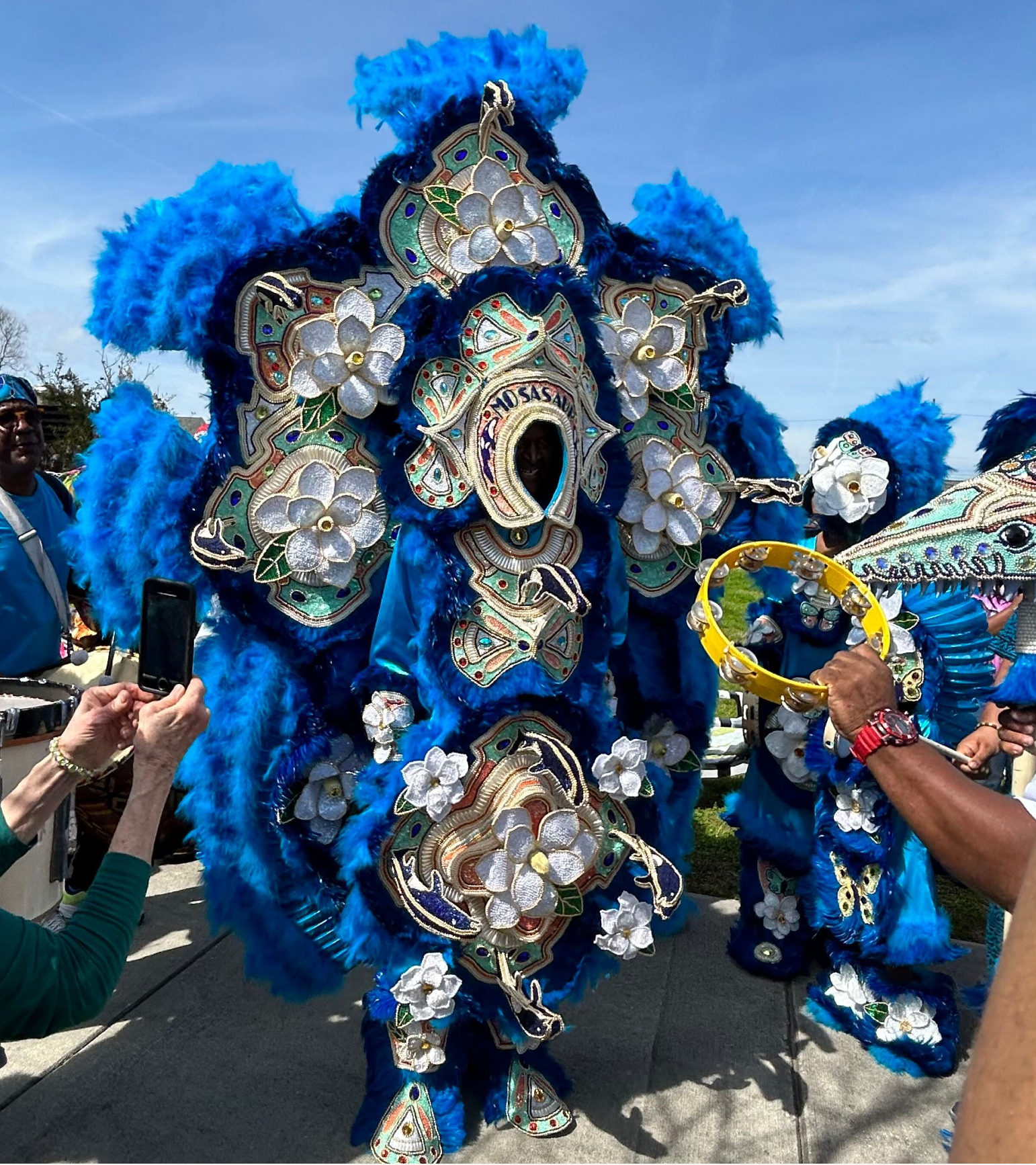
Shaka Zulu is a master of Black Masking suit design, an art form specific to New Orleans, Louisiana, which originated as part of the Indigenous and African culture in the city. The intricate suit-building of the New Orleans Black Masking carnival tradition usually involves sewing and designing for one full year, and are colorfully displayed during Mardi Gras, St. Joseph’s Night, and Super Sunday in New Orleans. In addition to upholding the Black Masking tradition, Zulu is revered as a drummer and stilt dancer, both part of the city’s West African traditions.
Born in New Orleans in 1969, Zulu grew up immersed in African and Caribbean culture by being a part of his father Zohar Israel’s performing arts company, Free Spirit, in New Orleans. He started drumming at an early age and became a master of African and African diasporic percussion instruments, such as the djunjun, djembe, shakare, and congas. Under the masterful tutelage of his father, Zulu, at the age of 15, became a skillful and accomplished second generation stilt dancer.
In 1995, Zulu and his wife Naimah formed the performing arts company, Zulu Connection, and toured their company of dancers, stilt dancers, and drummers nationally and internationally.
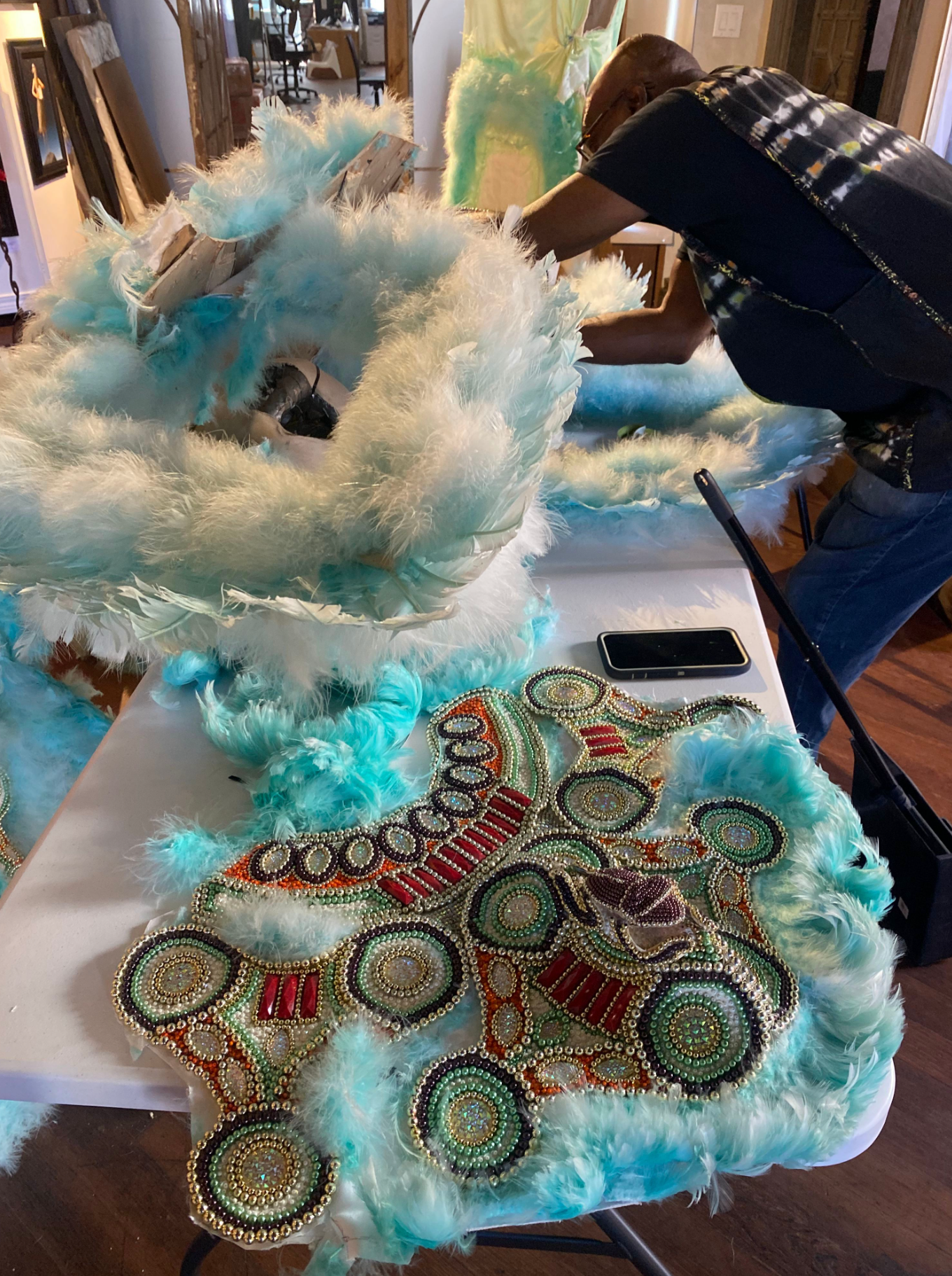
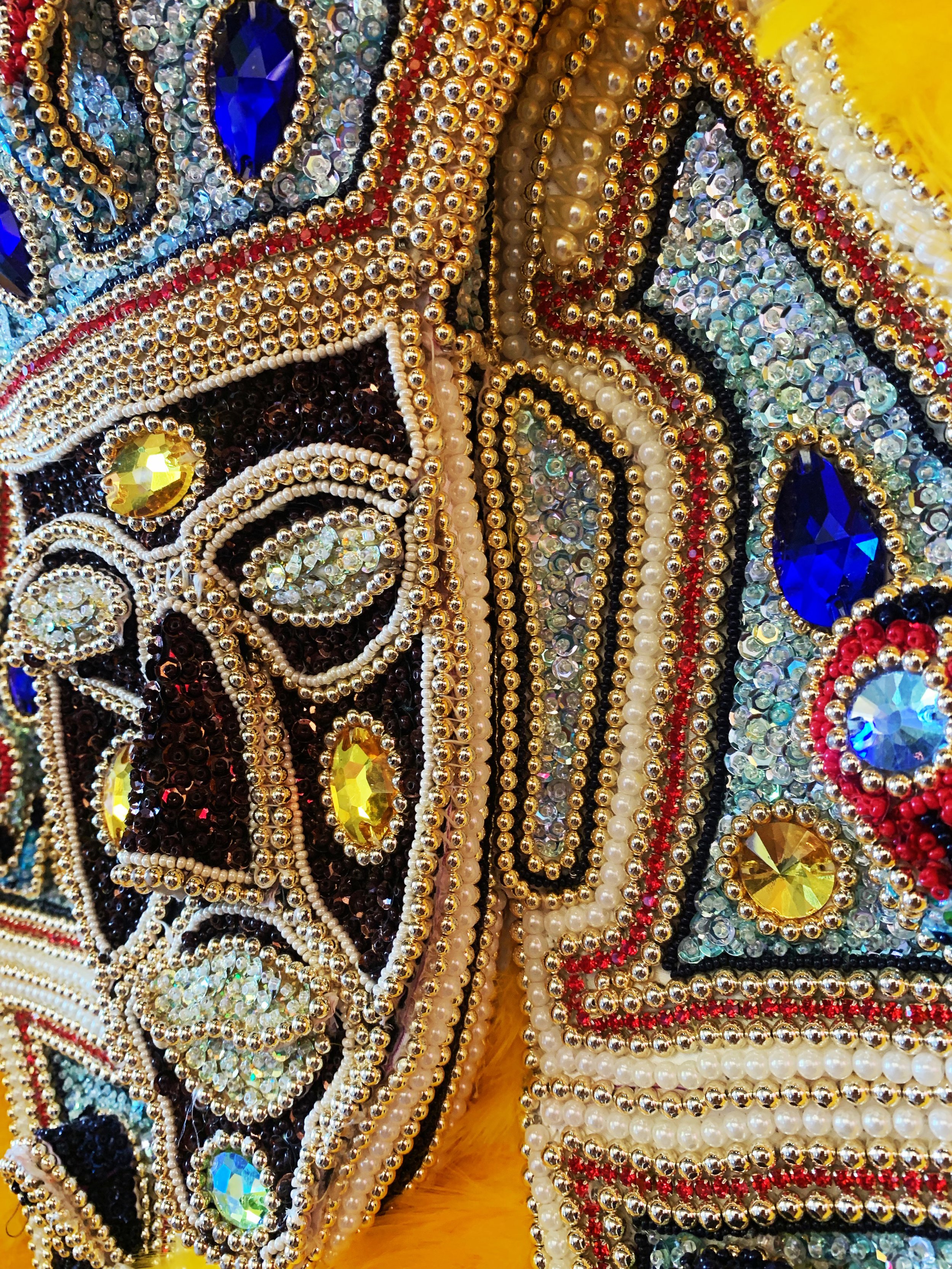
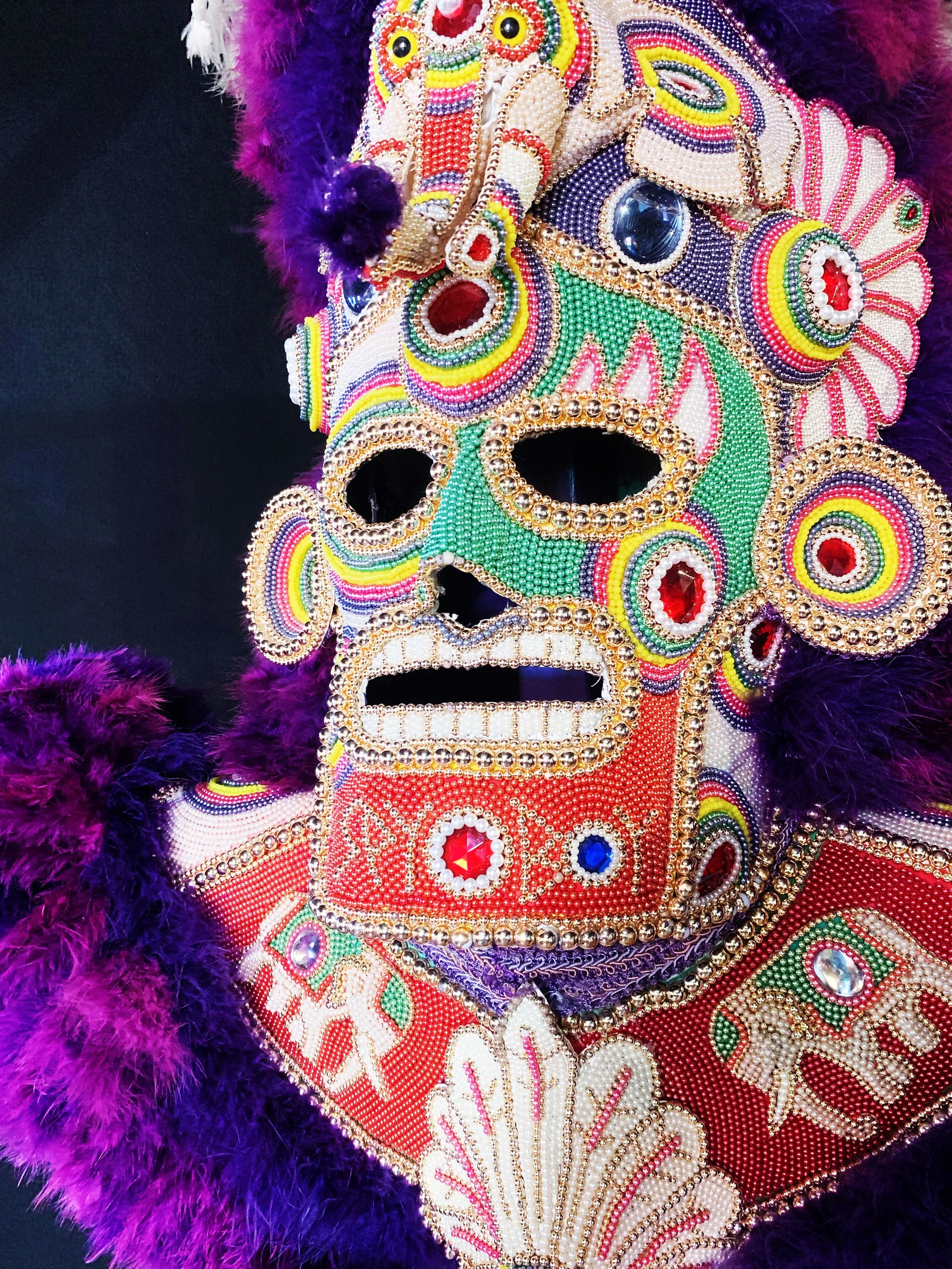
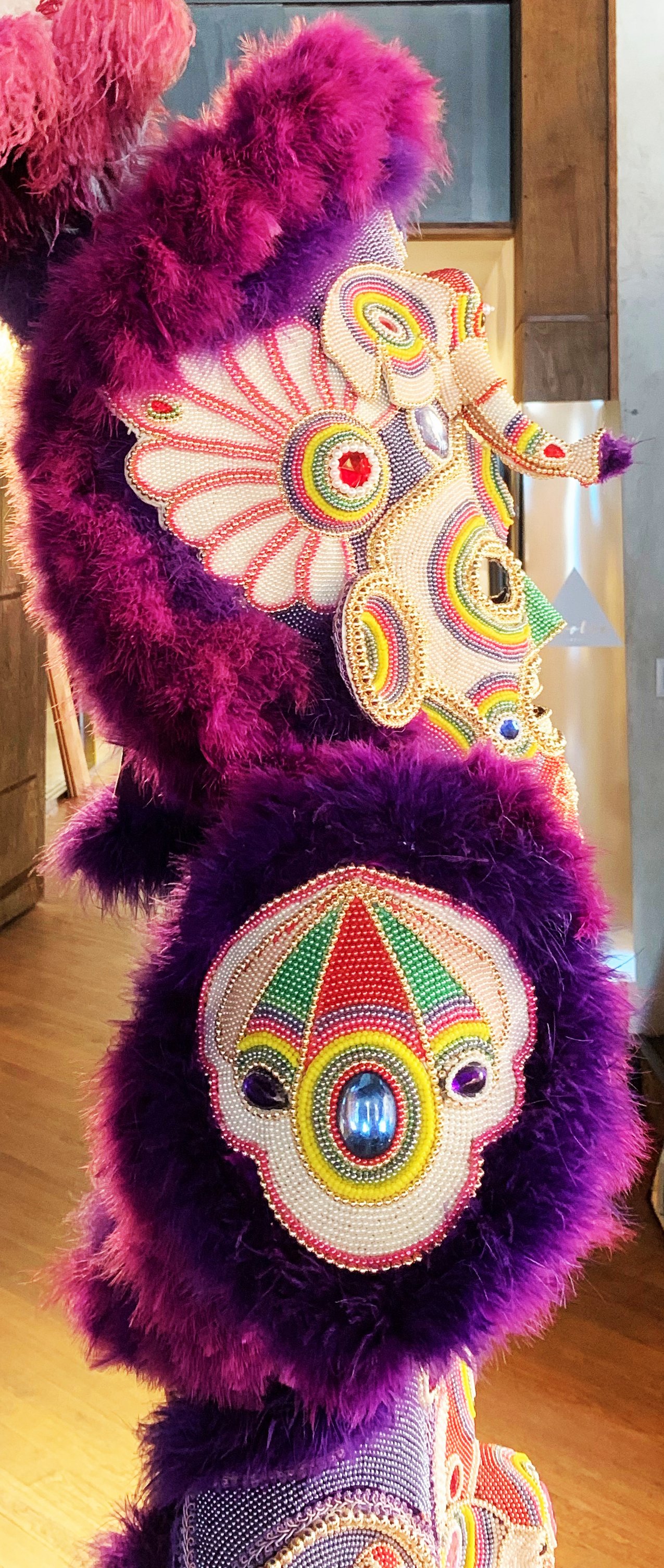
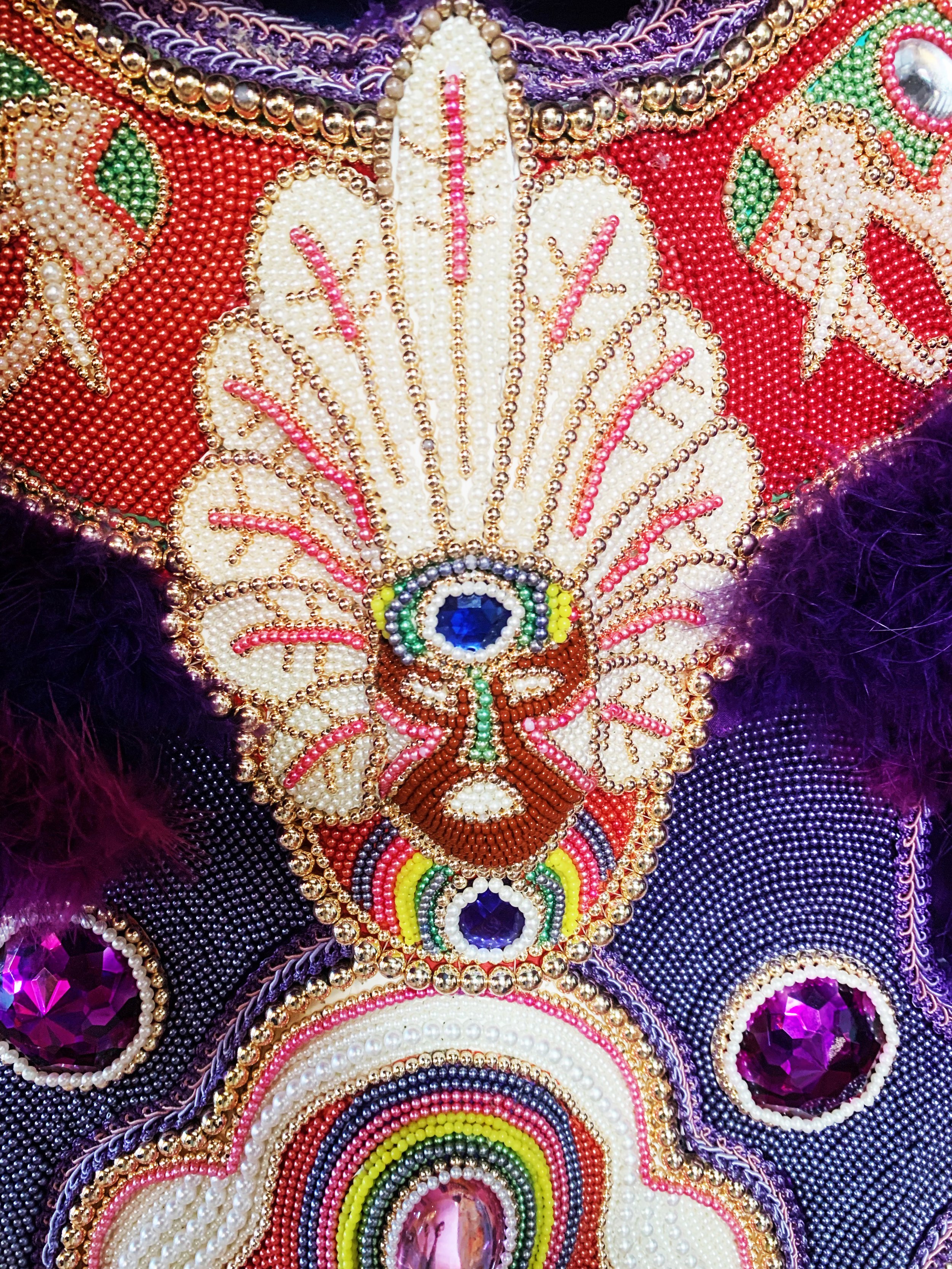
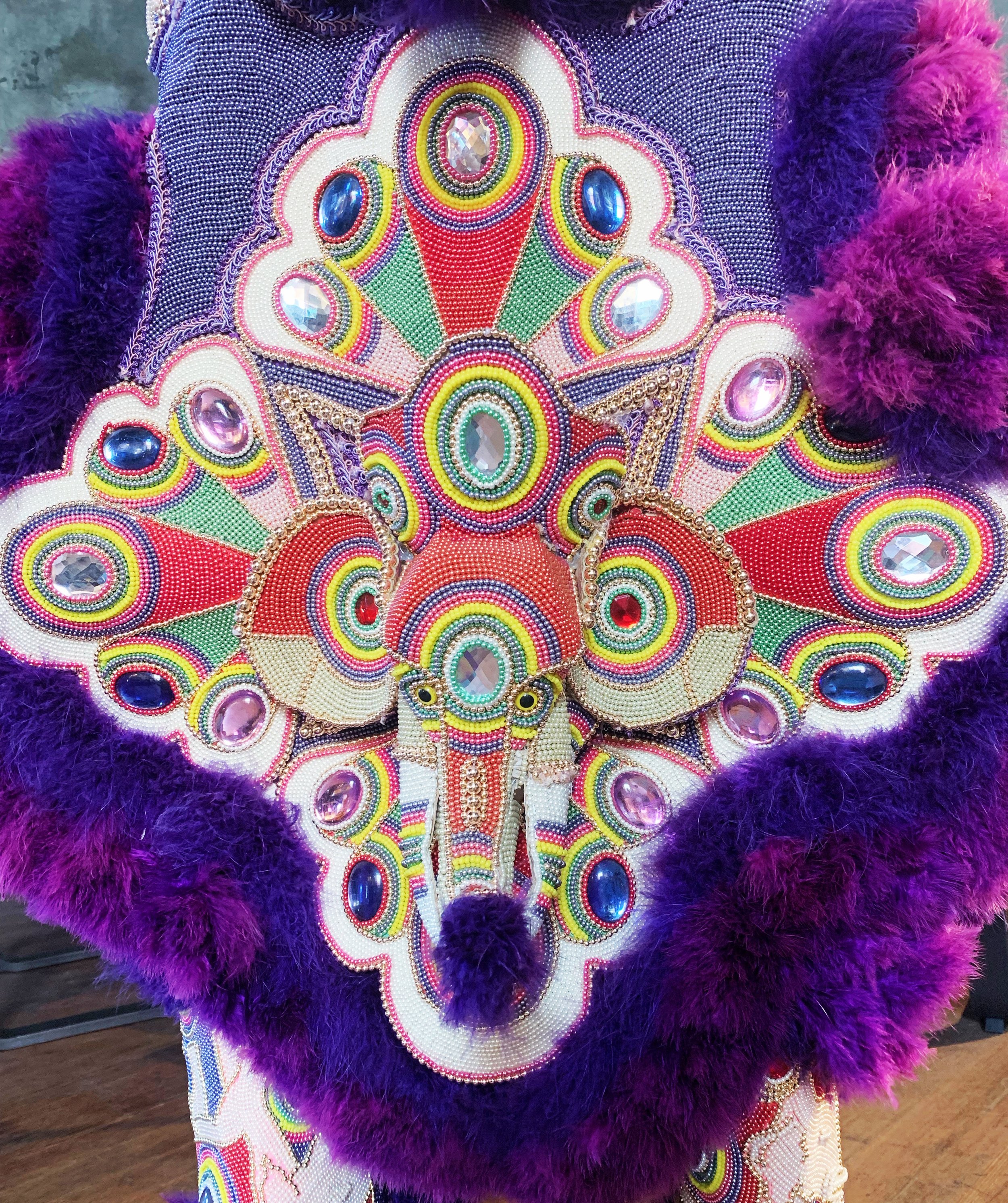
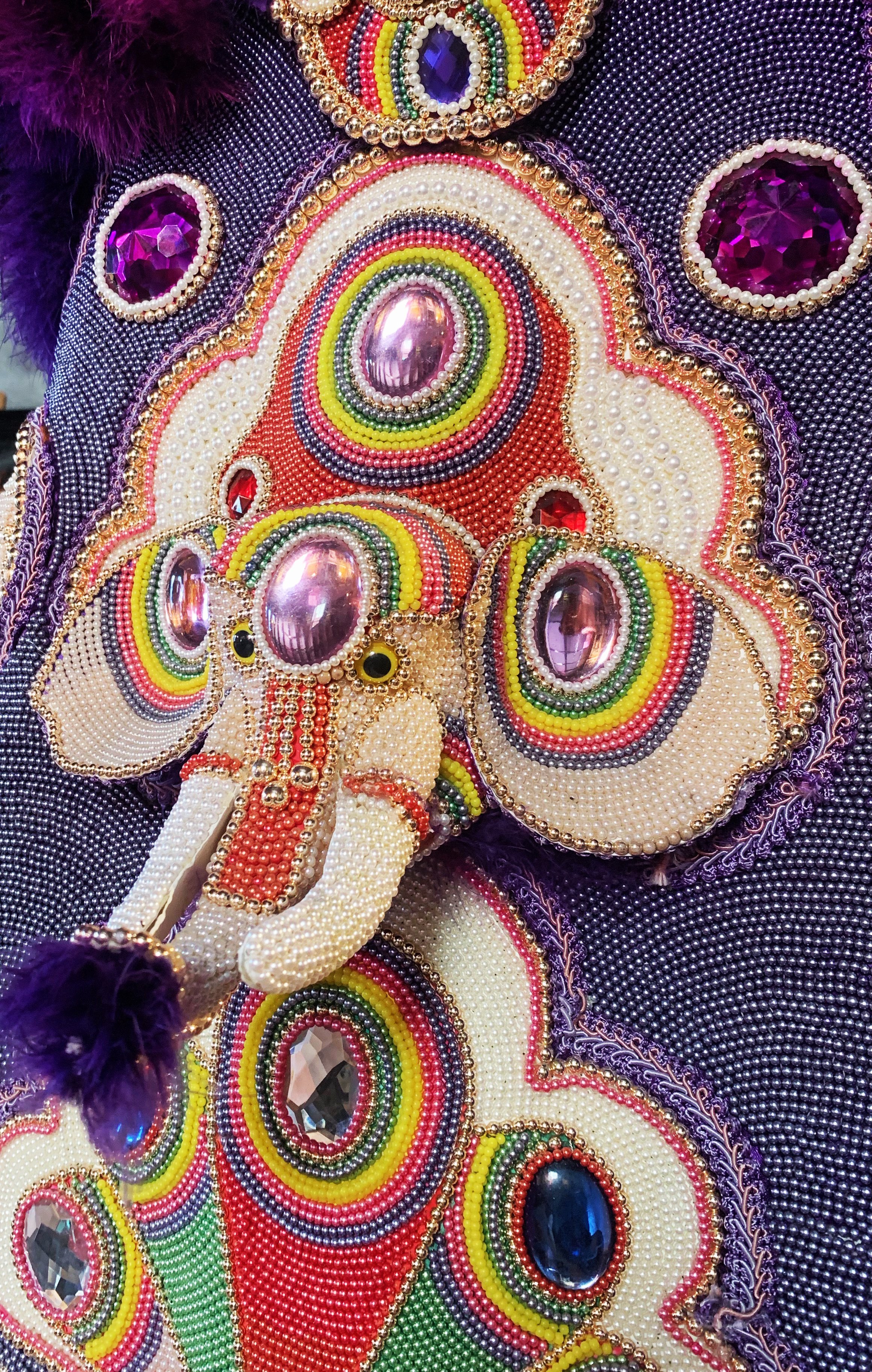
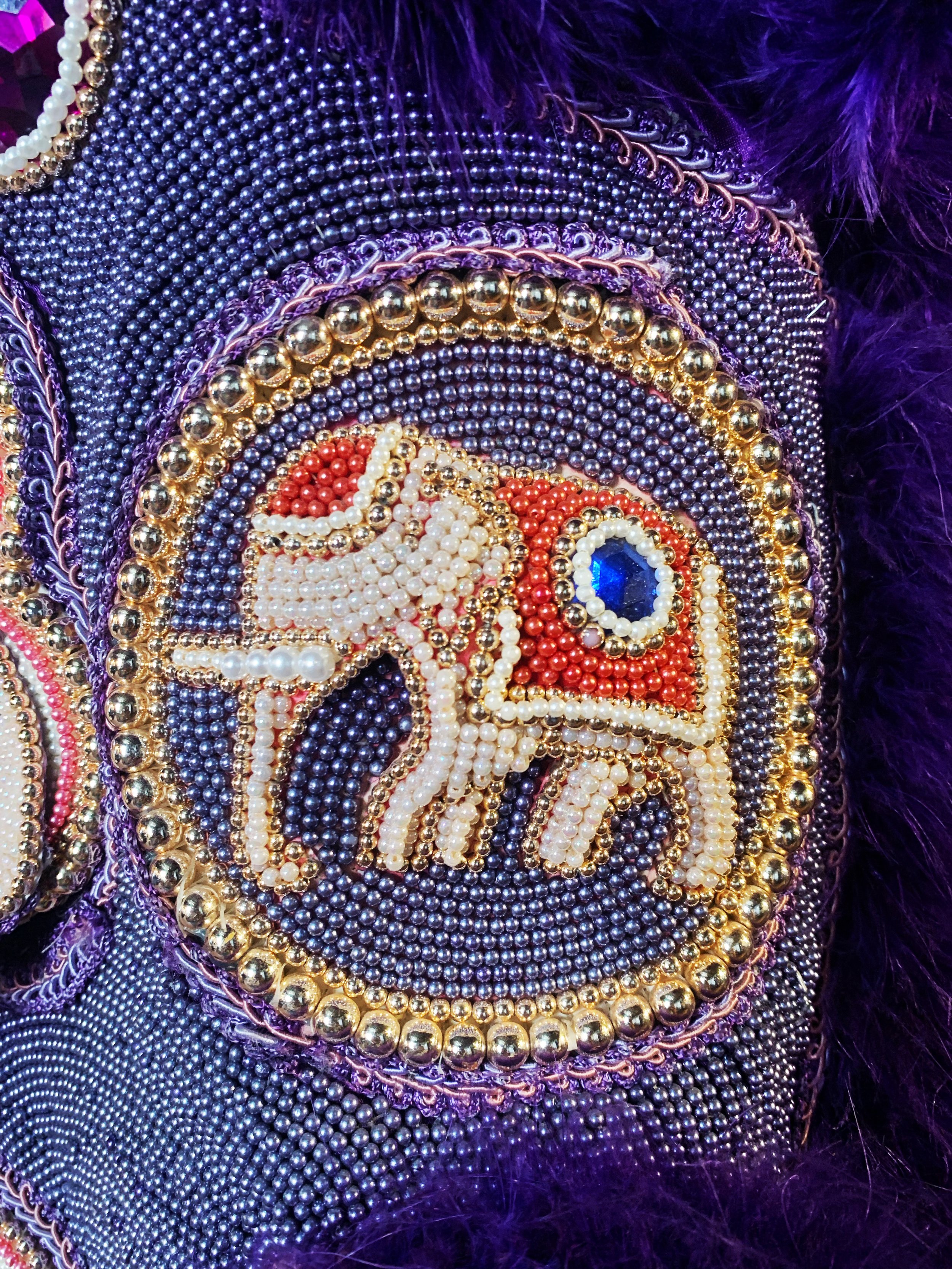
In 1999, he studied under Chief Darryl Montana, son of Chief Tootie Montana (1987 NEA National Heritage Fellow). His talent for impeccable sewing quickly led to his significant stature within the Black Masking tradition. He continues the “downtown” suit-making tradition pioneered by Chief Tootie Montana, distinguished by its three-dimensional or soft-sculpture pieces with sequins, beads, turkey feathers, and a more abstract style. Zulu is now Big Chief of the Golden Feather Hunters established in 2018.
A thought-provoking lecturer on the origin and culture of the Black Masking traditions of New Orleans, Zulu has exhibited his suits both nationally and internationally at museums and festivals. Following Hurricane Katrina in 2005, Zulu lectured and exhibited his suits at the DeYoung Museum in San Francisco. His 2015 suit was featured in Sounds of the City, an exhibit in Berlin, Germany, featuring the culture of New Orleans. His suit “Shango” is currently on exhibit in the Netherlands at the Africa Museum.
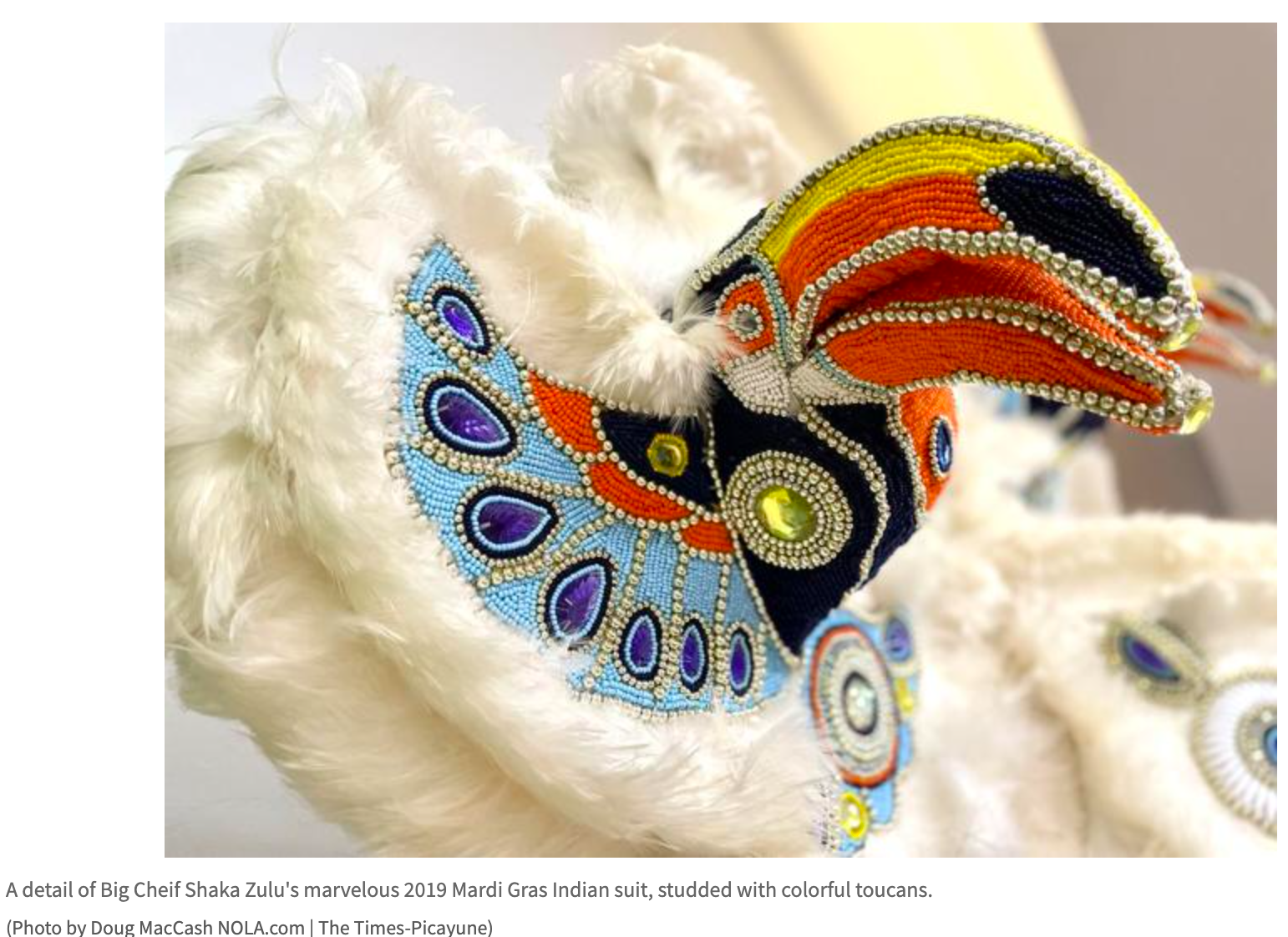
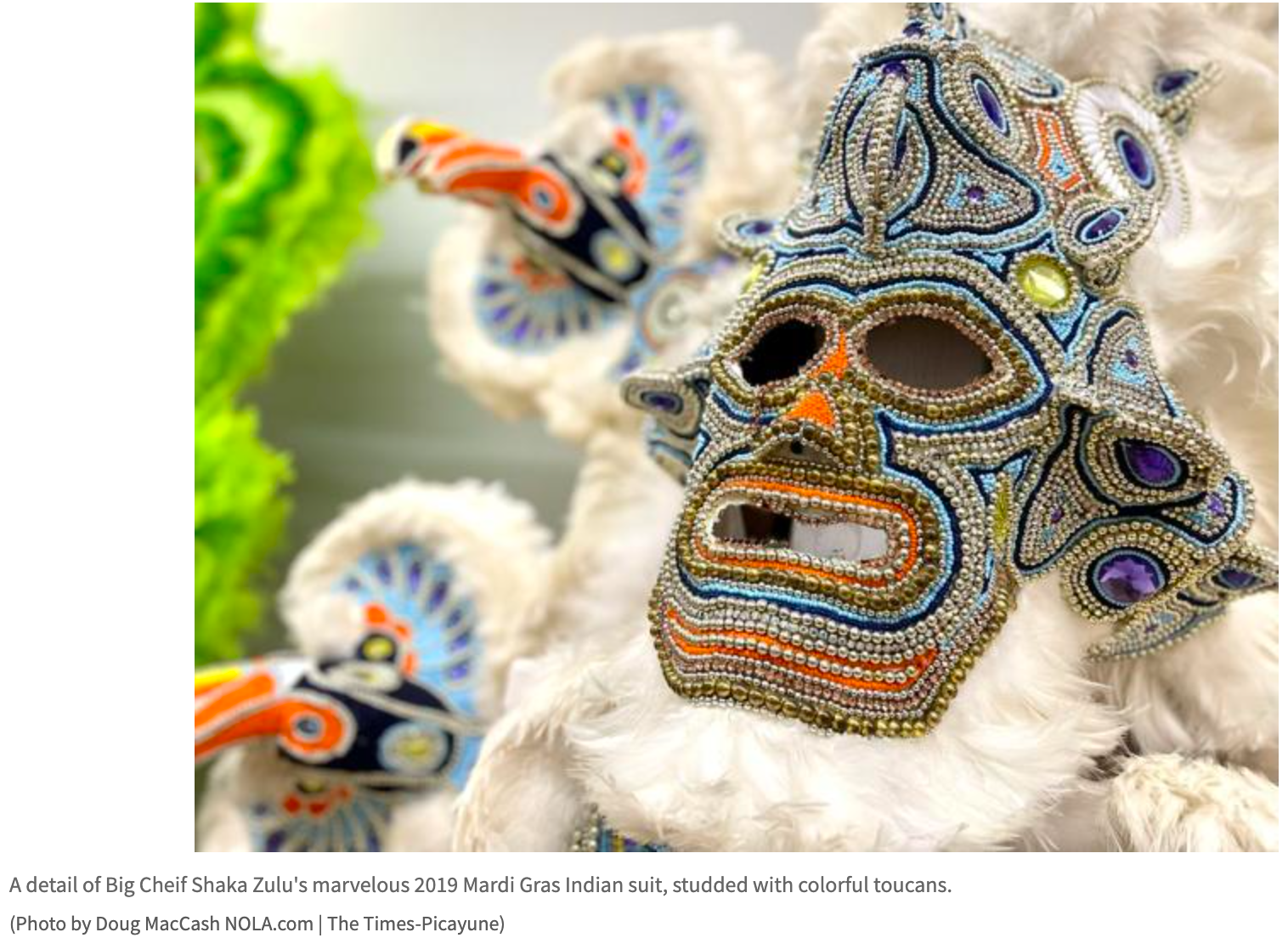
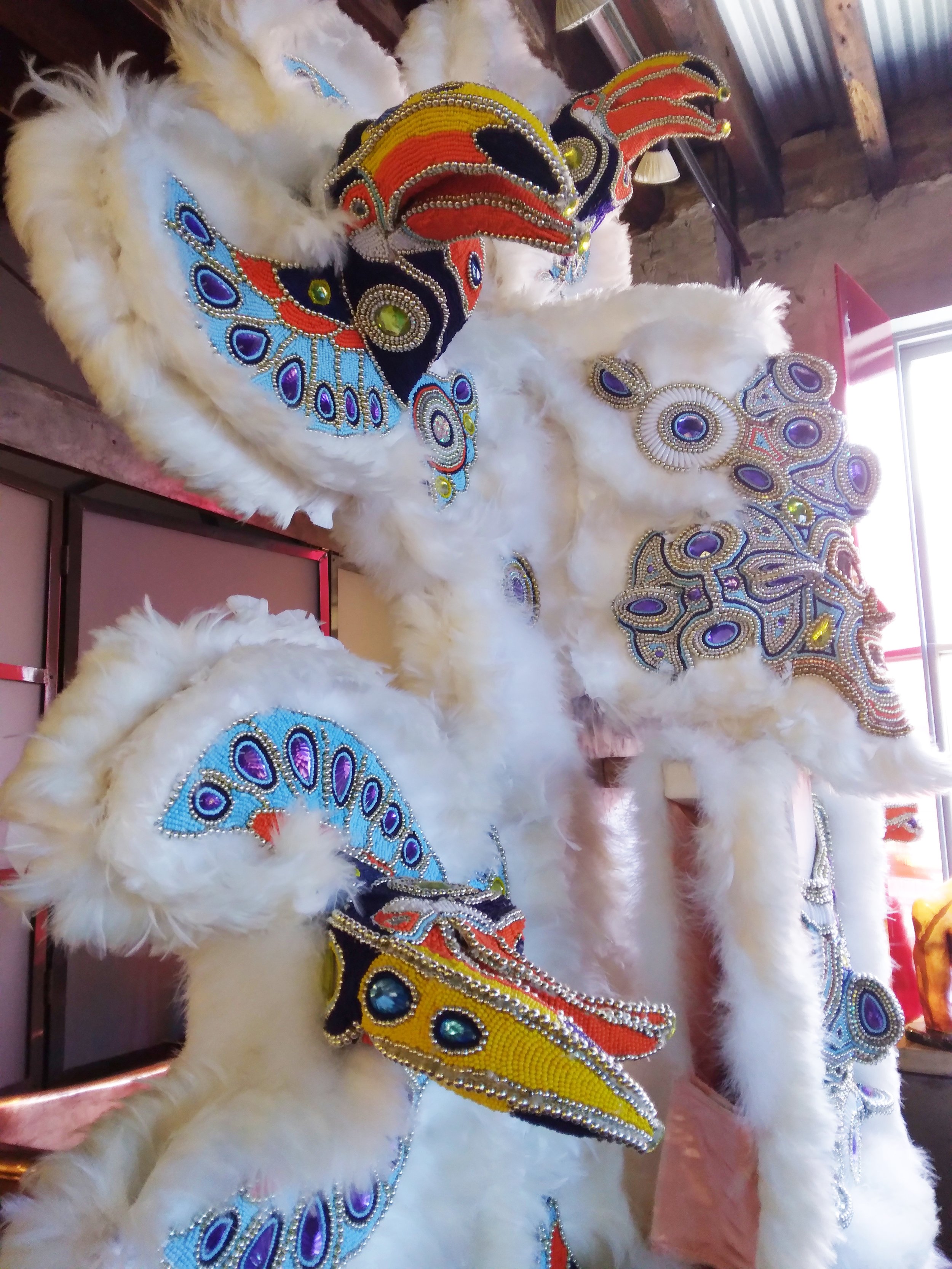
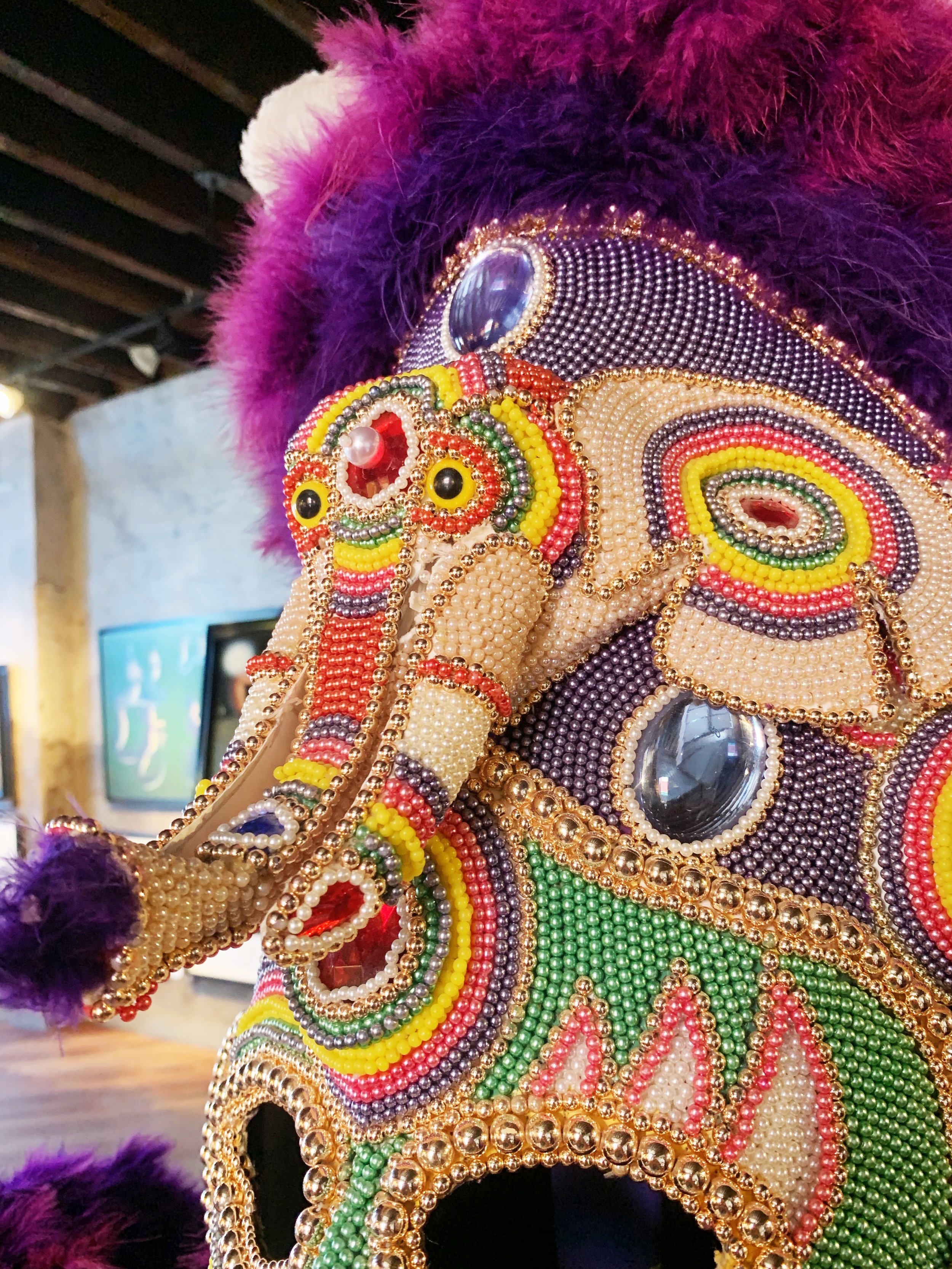
A consummate teacher and culture bearer, Zulu has conducted workshops on masking, drumming, and stilt dancing nationally and internationally. On trips to Tanzania in 2009 and 2019, he engaged with the Masai and Meru communities about the connection between the African and New Orleans African American traditions. It was in Tanzania in 2019 that Zulu beaded his 2019 Suit “The Toucan” with the diligent assistance of the youth in the villages of the Masai and the Meru people.
As part of New Orleans’ tricentennial in 2018, Zulu produced New Orleans Voices of Congo Square, a 30-cast member stage production featuring the Black carnival traditions of New Orleans, touring the show nationally and internationally, and making a film of the production.
According to Shaka Zulu’s customs and traditions, he has passed down the Black Masking and stilt dancing traditions to his daughter, Sarauniya, who continues these practices.
Mardi Gras Indian’s 'Monkey Mosaic' suit is a smile-making machine
BY DOUG MacCASH - NOLA.COM
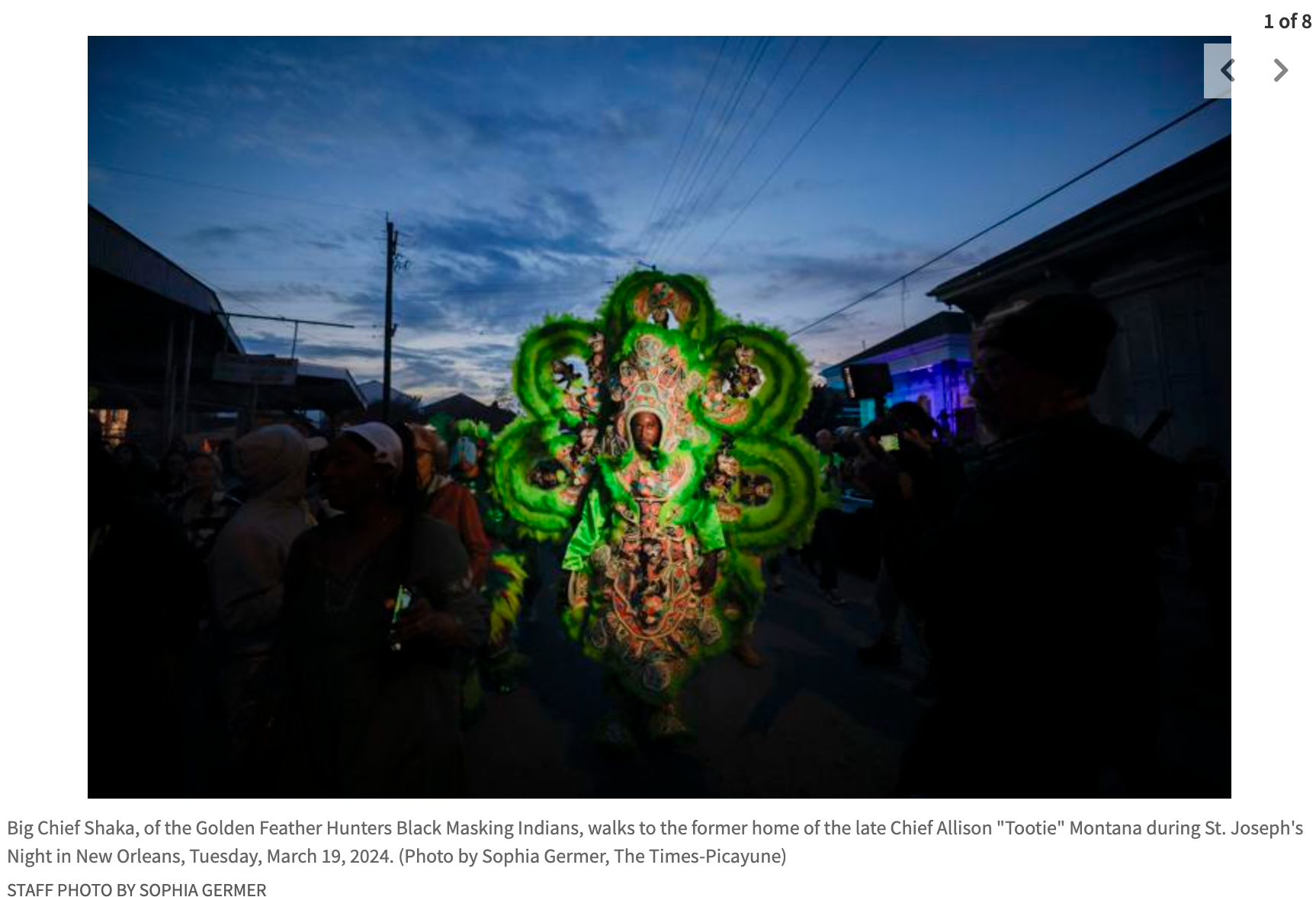
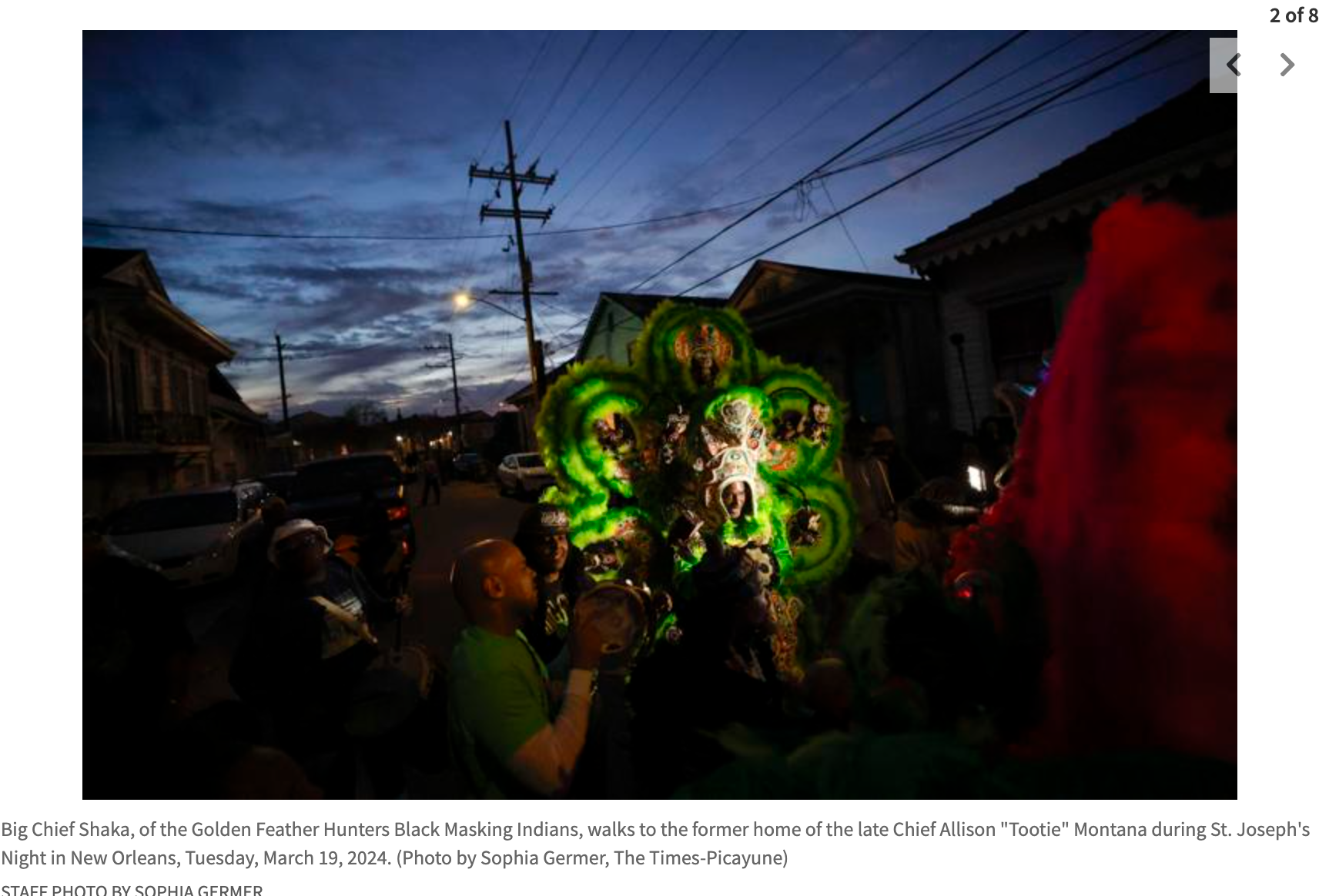


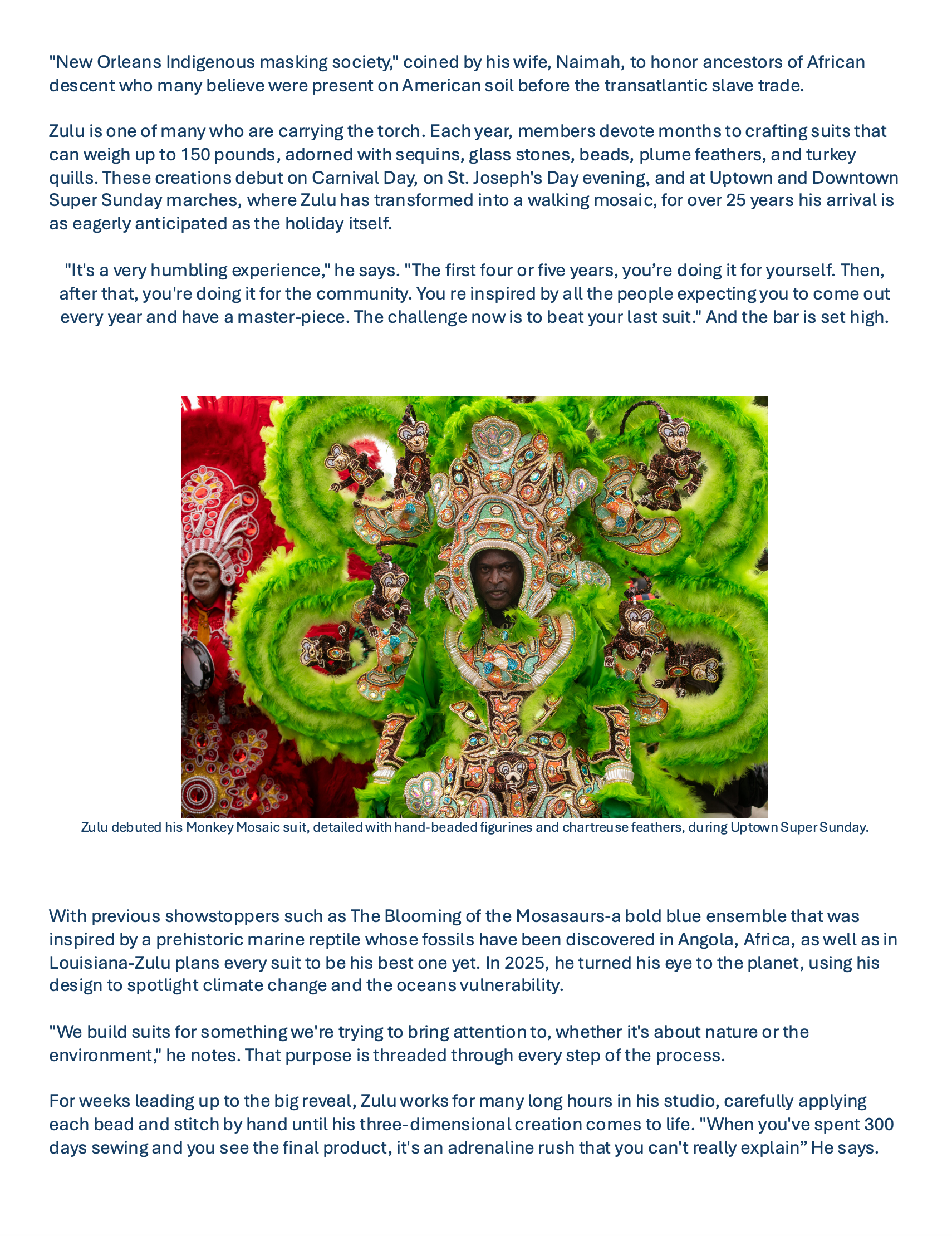
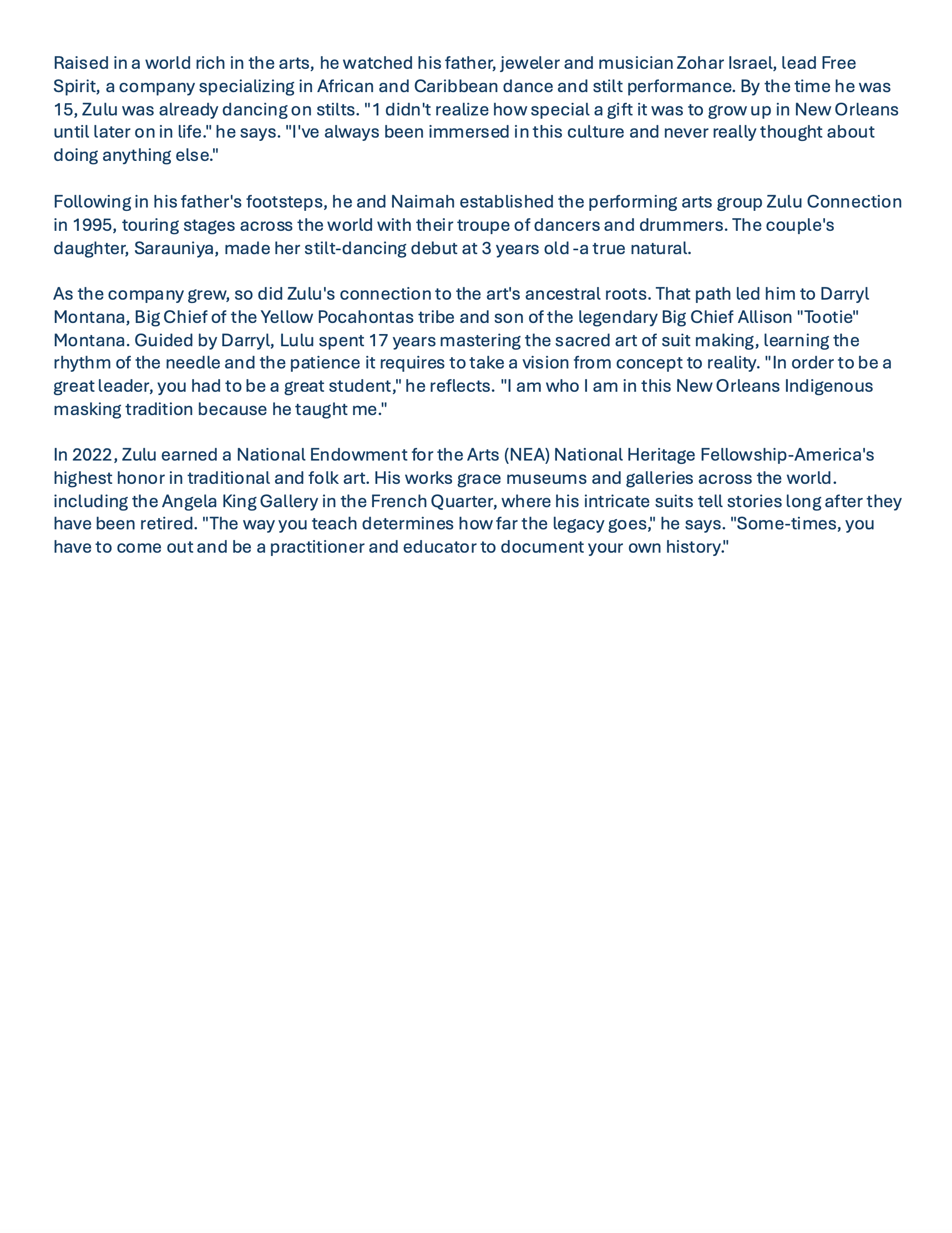
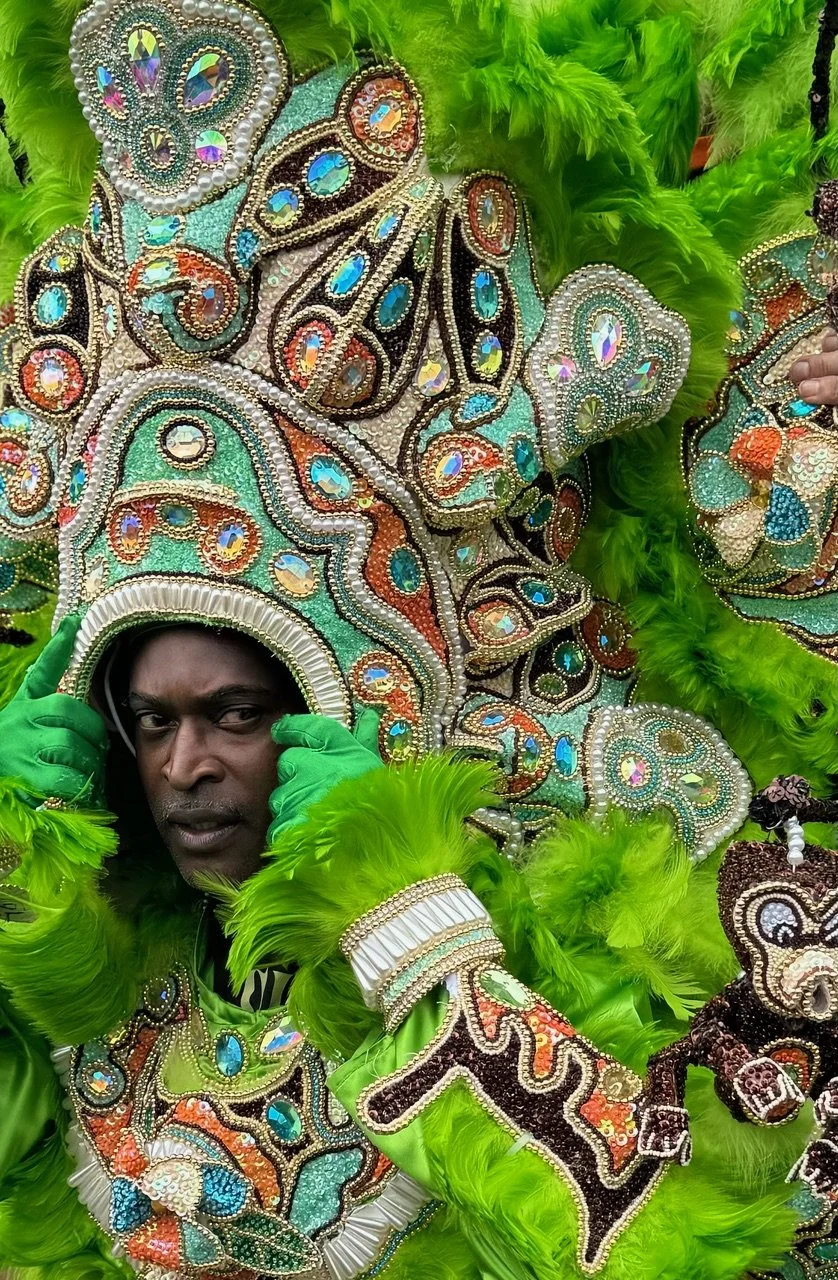
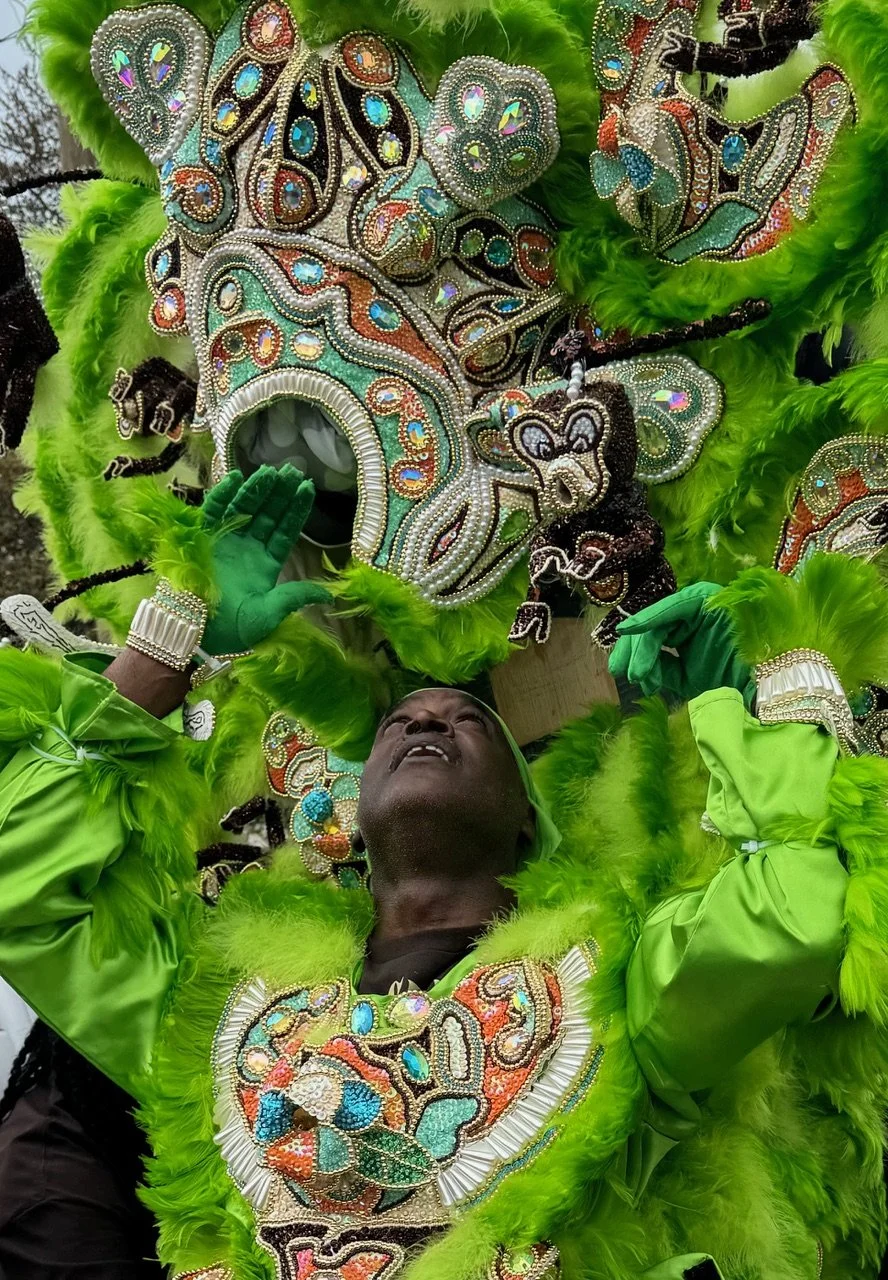
It’s not easy to stand out during a Mardi Gras Indian march. The procession of suits is like a feathery fireworks show, one loud explosion of color and sound after another. But, as anybody along the curb during last week’s Uptown Super Sunday parade can tell you, Big Chief Shaka Zulu’s “Monkey Mosaic” suit was a showstopper.
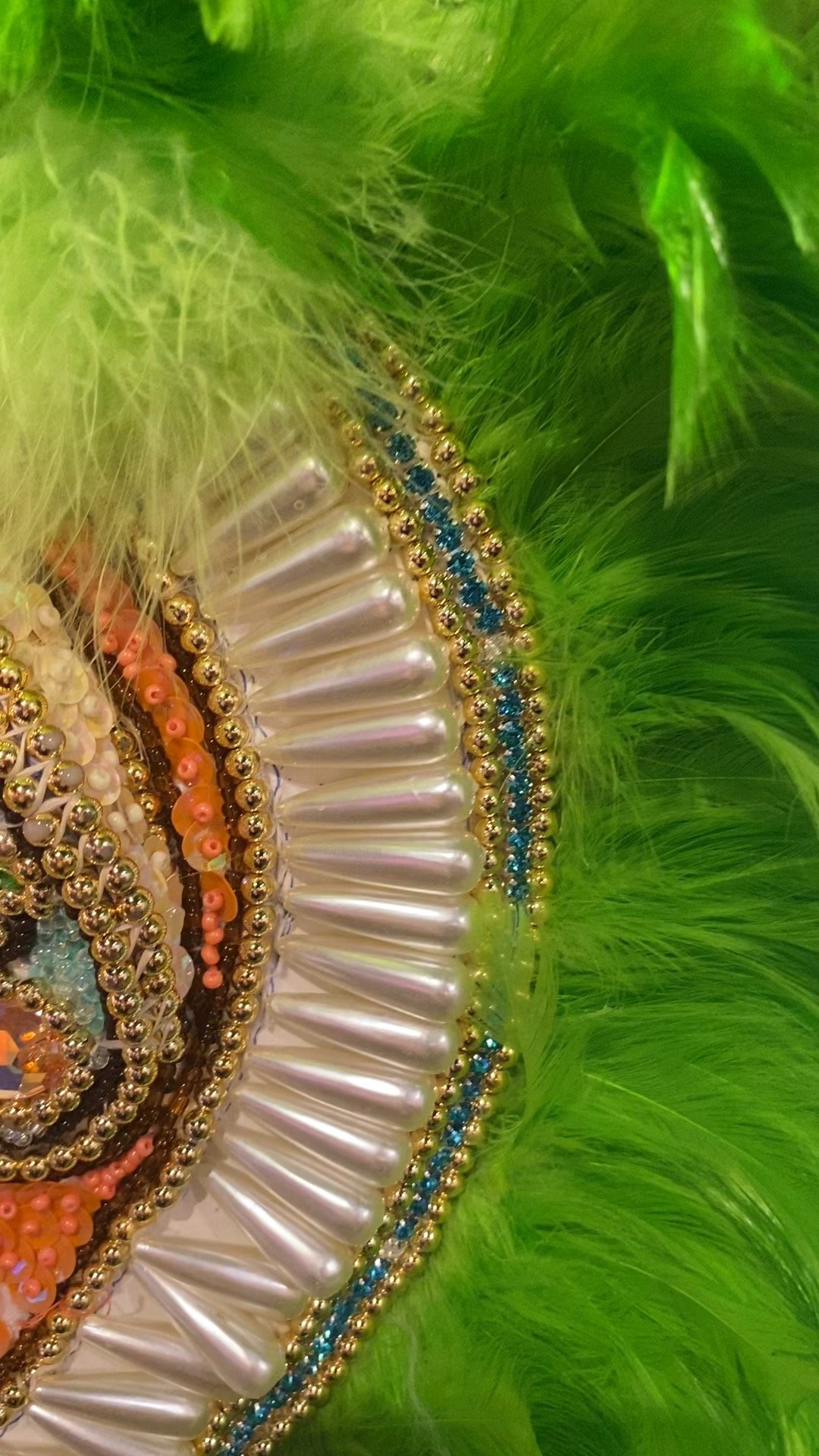
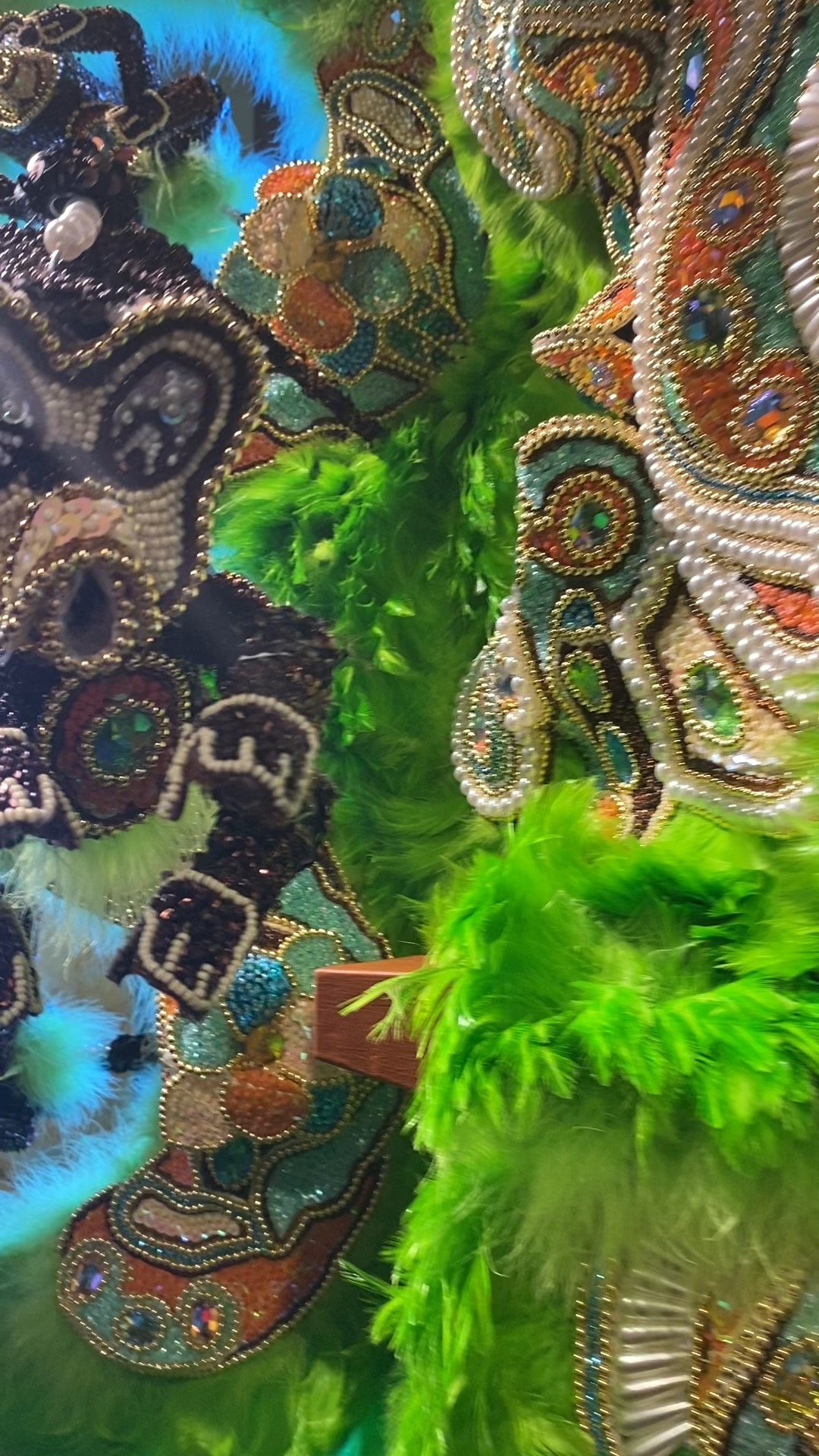
Trimmed with thousands of turquoise and coral-colored glass beads and gems, the suit was stunningly beautiful to begin with, and the craftsmanship was exquisite. But what caused the crowd to gasp in delight was the troupe of beaded monkeys that seemed to cavort amid the suit’s chartreuse-green feathers.
There were at least a dozen of the little sequined simians glinting from gaps in the suit. A few of them were suspended from springy wires, so that they seemed to be leaping in space, just like the real thing. Chief Zulu said he intended to capture “the vivacity and agility inherent in these creatures.”
Just imagine how thrilling the sight was was for little kids. Zulu’s suit is a smile-making machine.
A pinnacle of fine art
The age-old Mardi Gras Indian tradition combines aspects of Native American ceremonial dress with African beading customs and other rituals into a uniquely New Orleans form of self-expression. Mardi Gras Indian suits are revered around the world as a pinnacle of fine art.
Participants produce a new suit each year, which they wear on Mardi Gras, St. Joseph’s Day evening, during Super Sunday marches, and a few other select events. Suits are then retired and sometimes disassembled. In the old days, the suits were sometimes tossed on a fire or otherwise destroyed after having been seen publicly.
Some suit-makers prefer the term Black Masking Indians or just Black Indians to the phrase Mardi Gras Indians. Chief Zulu said that his favorite description of the custom is New Orleans Indigenous Masking Society Culture. He credits the precise term to his wife Naimah Zulu.

A unique culture
A 9th Ward native, Zulu has been surrounded by New Orleans’ particular brand of parading and music since he was a kid. He’s a master stilt dancer and drummer, and for the past 25 years has spent countless hours sewing intricate suits with the assistance of a community of friends. “Nobody can do this by themselves,” he said of suit-making.
Zulu, who is 55, began masking with the renowned Yellow Pocahontas, and is now leader of the Golden Feather Hunters. In 2022 he was awarded a National Endowment of the Arts National Heritage Fellowship for his cultural accomplishments. A North Carolina brewery decorates limited edition beer cans with pictures of his suits.
A sequined sea monster
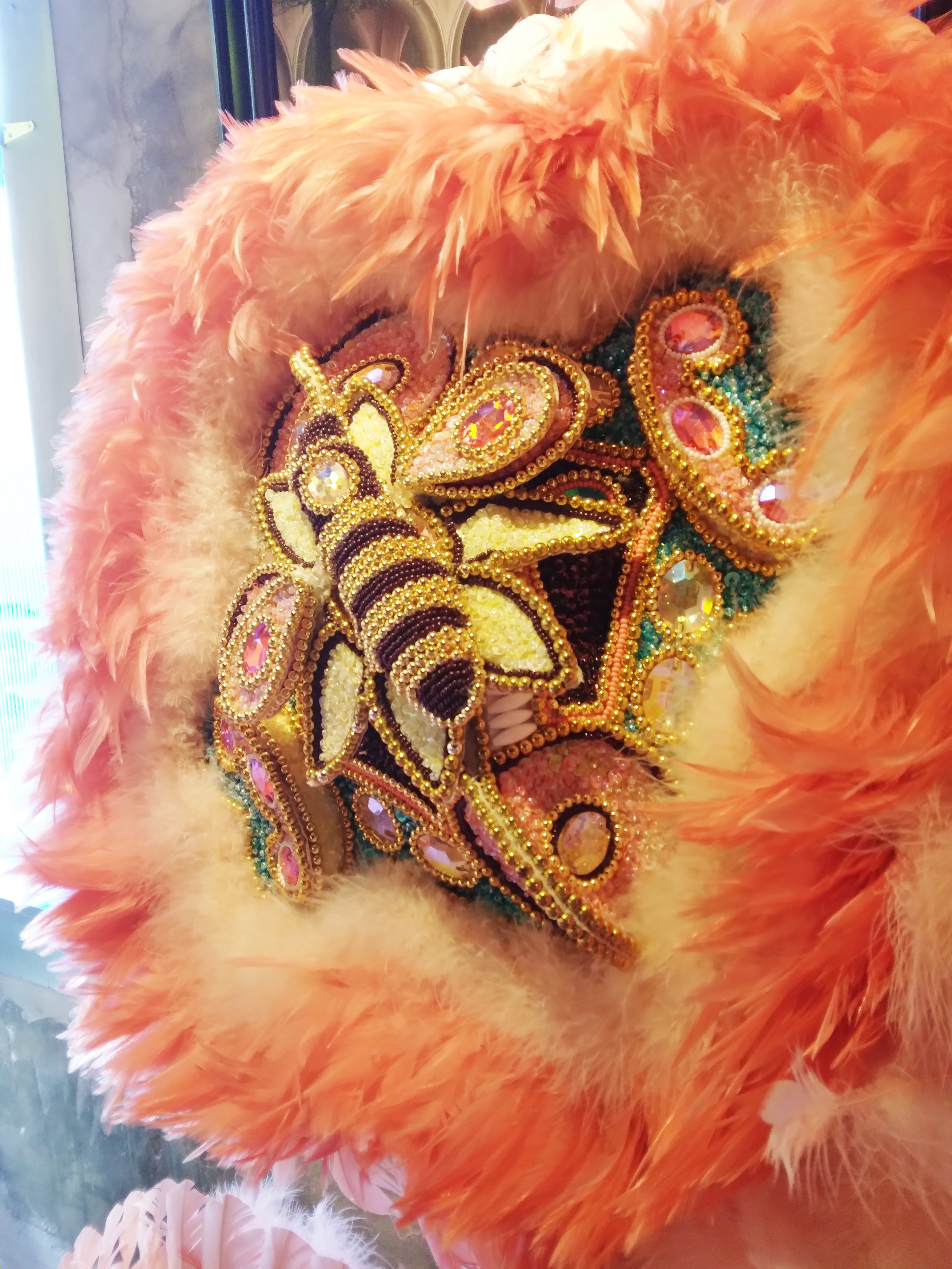
Zulu said his annual theme usually has something to do with the natural world. A few years back he studded a suit with a flock of colorful toucans, then created a swarm of glittering bees.
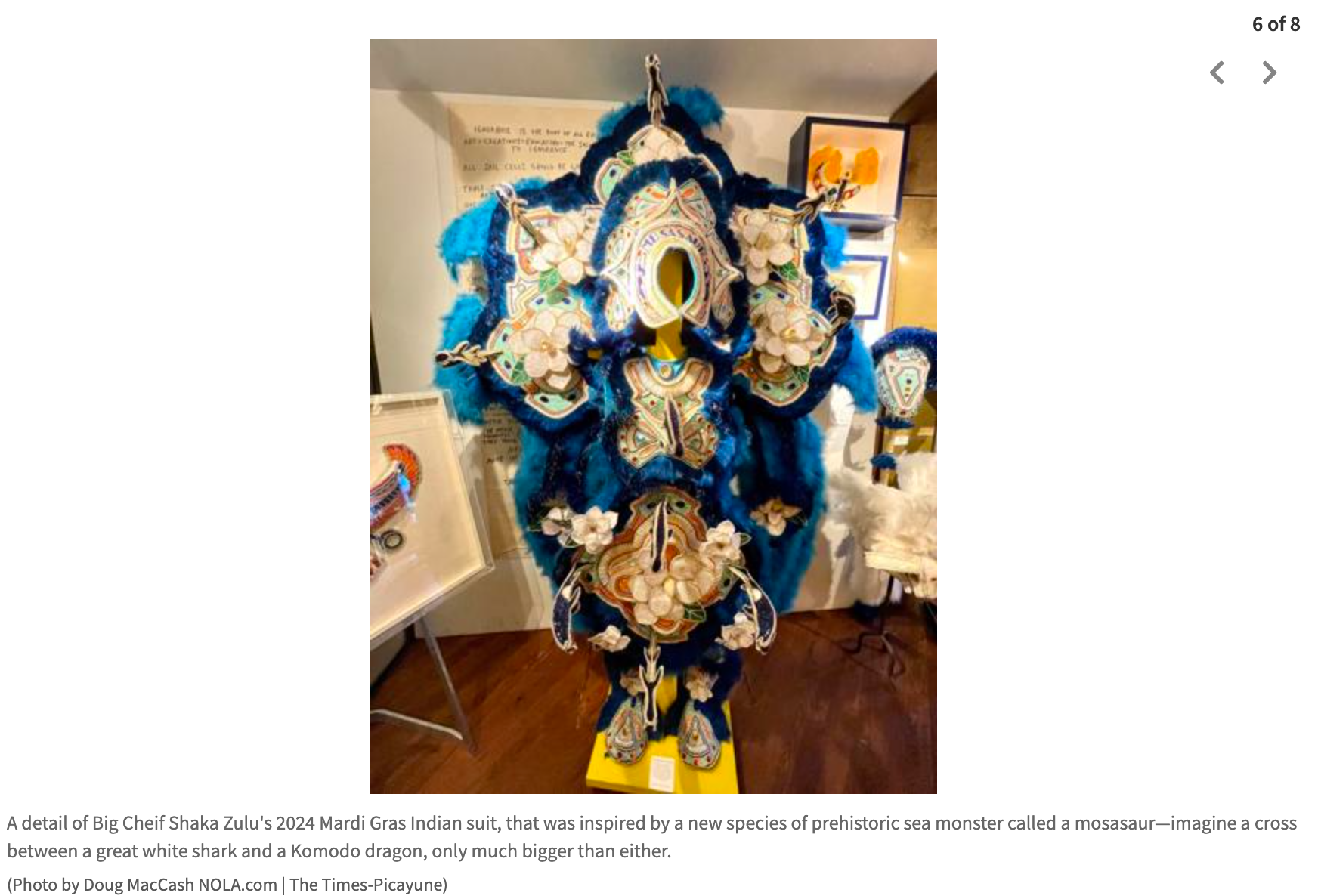
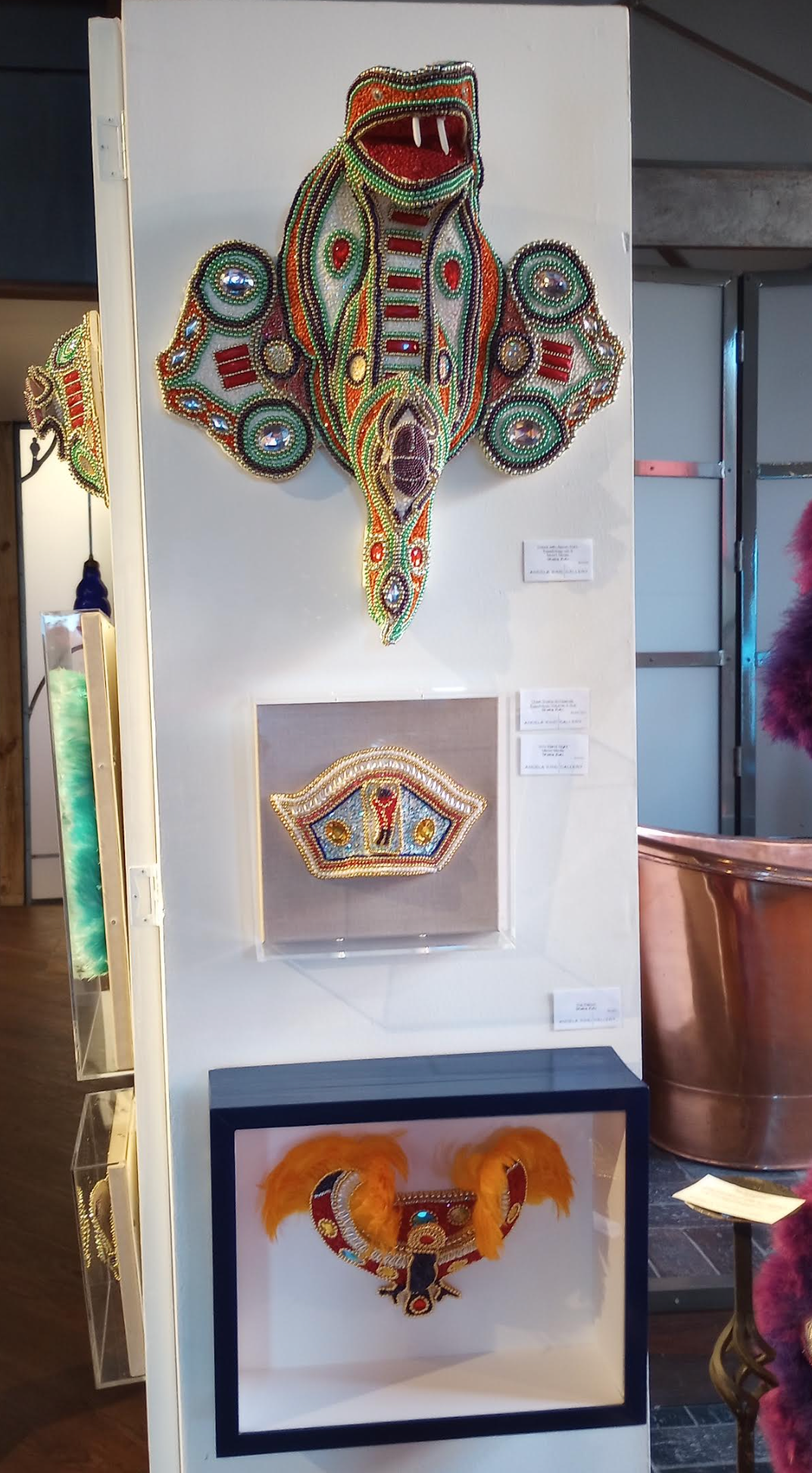
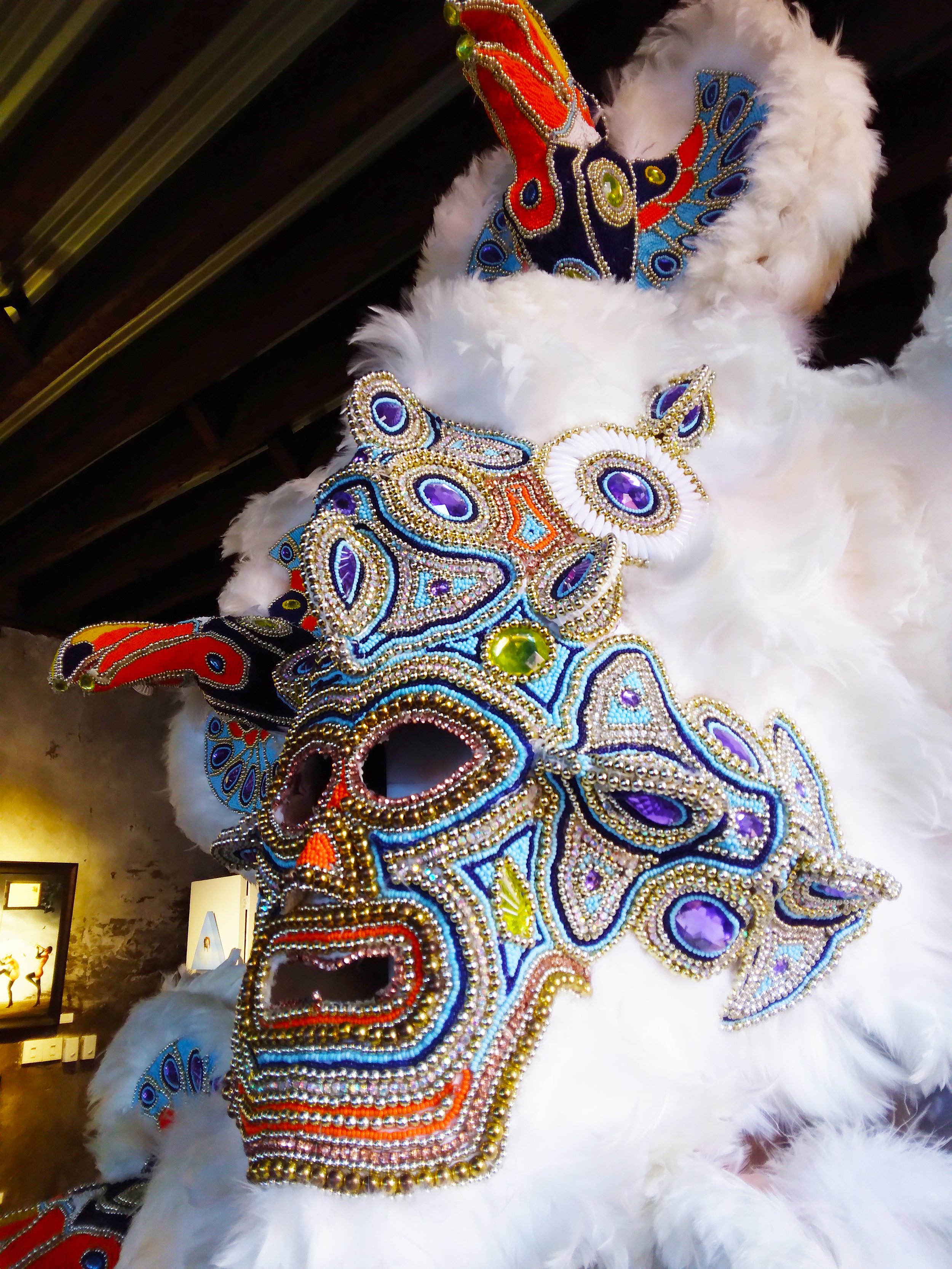
Last year's suit may have been the most unusual. It was inspired by the discovery of a new species of prehistoric sea monster called a mosasaur — imagine a cross between a great white shark and a Komodo dragon, only much bigger than either.
Fossils of the “new” type of mosasaur were excavated in the Republic of Angola in Central Africa, the historical homeland of many of the enslaved people who were brought to New Orleans. Zulu said his wife can trace her family’s origin to Angola. For Zulu, the fearsome ancient creature symbolized the cultural connections between the continents.
Wise, adaptable, and intelligent creatures
Which brings us back to the monkeys. Zulu has traveled all over Africa. On a trip to the Arusha National Park in Tanzania, he was delighted by the quantity and variety of the monkeys he encountered. They were the perfect theme for a future suit. As he explained, his 2024 suit is meant to embody “the wisdom, adaptability, and intelligence historically associated with monkeys in various cultures.”
Happily, if you missed the Uptown Super Sunday Mardi Gras Indian march on March 24, you have another chance to catch Zulu’s “Monkey Mosaic” suit. Just find a good spot along the route of the Downtown Super Sunday parade that takes place at noon April 7 and await the Golden Feather Hunters.
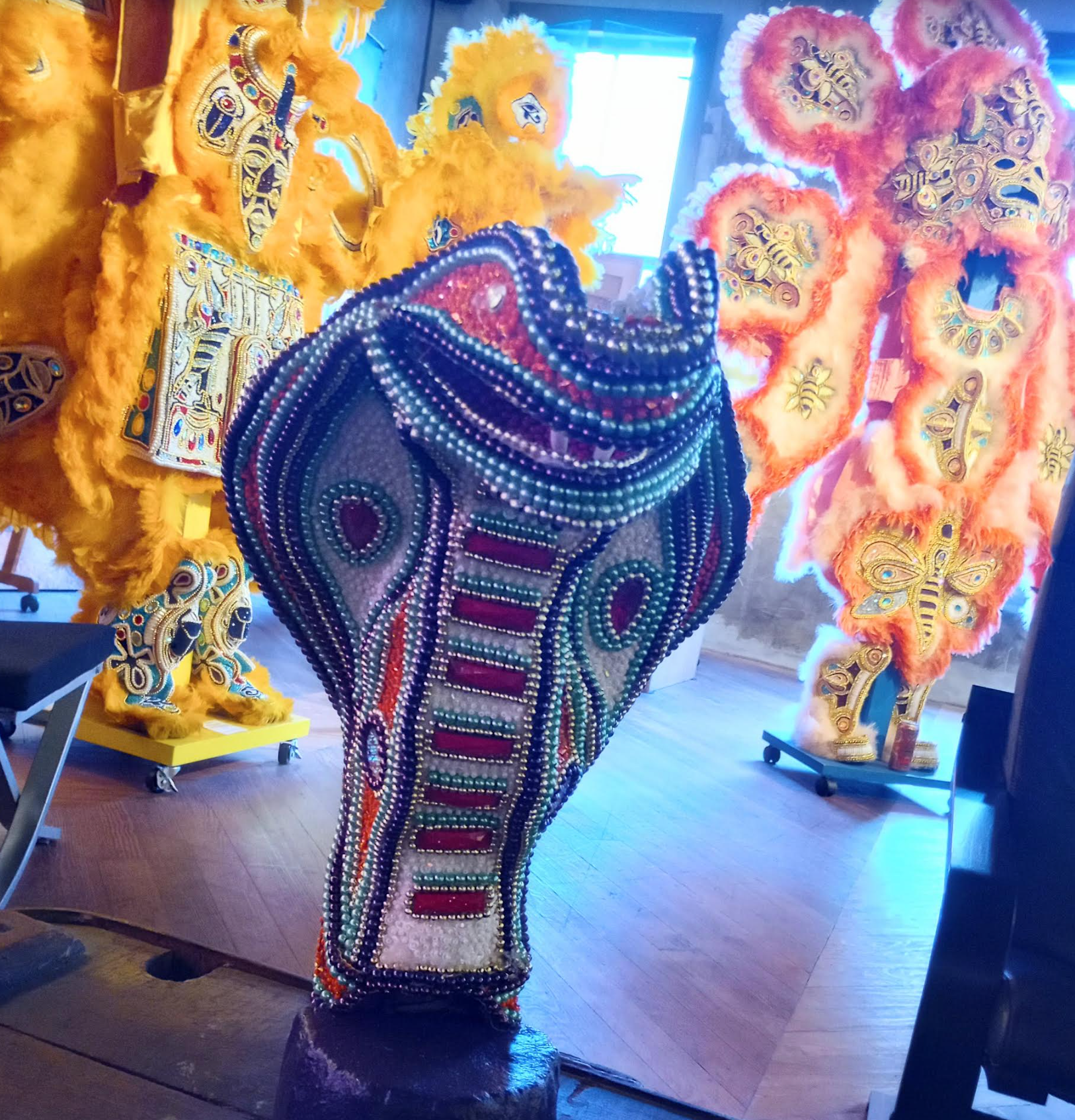
After the spring parading season passes, you’ll be able to see Zulu’s 2024 masterpiece at Angela King art gallery in the French Quarter where he displays and sells his retired creations — the beehive and the mosasaur suits are currently on display among others. Zulu said that his past suits are priced in the “six-figure” range and individual parts of suits sell for thousands. Angela King gallery is located at 241 Royal St. For more information, visit angelakinggallery.com.
ARTWORK


Preserve the Tradition. Protect the Culture. Keep the Feathers Flying.
Passing the Feathers Forward
For generations, the Black Masking Indians of New Orleans have created breathtaking works of art—intricate, hand-sewn suits of beads, rhinestones, and feathers. This tradition, born from resistance and resilience, is far more than an art form. It is a sacred cultural inheritance and the spiritual backbone of our communities.
Today, that inheritance is at risk. Essential plume feathers can cost up to $600 per pound, and a single chief's suit often requires several pounds.
This staggering cost is forcing the tradition's most venerable keepers, our elders, to step back. It is barring the next generation from participating. This threatens to break the vital, intergenerational chain of knowledge. When a culture bearer can no longer afford to mask, we don't just lose a suit—we lose a piece of the living soul of New Orleans.
National Endowment for the Arts Announces 2022 NEA National Heritage Fellows
Chief Shaka Zulu is a National Endowment for the Arts Folk Heritage Fellow, an honor recognizing his mastery and cultural contributions to New Orleans’ Indigenous Masking Society tradition. This art form, rooted in Indigenous and African diasporic heritage, represents one of New Orleans’ most distinctive cultural practices and continues to evolve as a living expression of identity. Chief Shaka contributes to this lineage through technical excellence and cultural stewardship, serving on the New Orleans UNESCO Creative City for Music Advisory Board, acting as an ambassador for the Louisiana Music and Heritage Experience, and appearing on CNN’s Sounds of the City. His suits have been exhibited nationally and internationally in the Netherlands, Germany, France, Japan, and Morocco, demonstrating the global resonance of his artistic practice. Also a musician and stiltdancer, he works through multiple pathways of performance and pedagogy that reinforce New Orleans as a global cultural center.
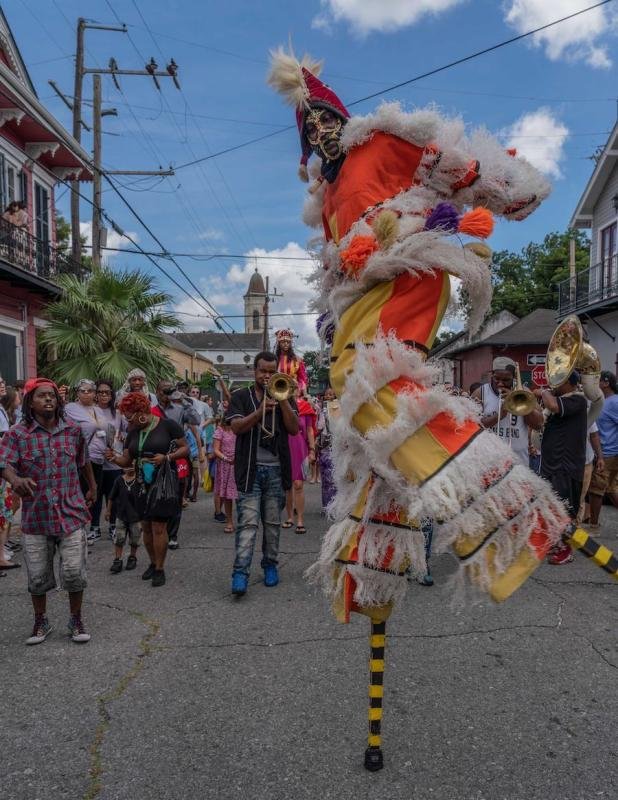
A master of New Orleans Black Masking, drumming, and stilt dancing, Shaka Zulu passes down the traditions as a teacher and culture bearer whose talents are celebrated nationally and internationally.
About the National Heritage Fellowships
The National Heritage Fellowships are the nation’s highest honor in the folk and traditional arts. Including the 2022 class, the Arts Endowment has awarded 467 National Heritage Fellowships since 1982, recognizing artists working in more than 200 distinct art forms.
Fellowship recipients are nominated by the public, often by members of their own communities, and then judged by a panel of experts in the folk and traditional arts. The panel’s recommendations are reviewed by the National Council on the Arts, which sends its recommendations to the Arts Endowment chair, who makes the final decision.
About the National Endowment for the Arts
Established by Congress in 1965, the National Endowment for the Arts is the independent federal agency whose funding and support gives Americans the opportunity to participate in the arts, exercise their imaginations, and develop their creative capacities. Through partnerships with state arts agencies, local leaders, other federal agencies, and the philanthropic sector, the Arts Endowment supports arts learning, affirms and celebrates America’s rich and diverse cultural heritage, and extends its work to promote equal access to the arts in every community across America.
IMAGES FROM CARNIVAL DAY 2023
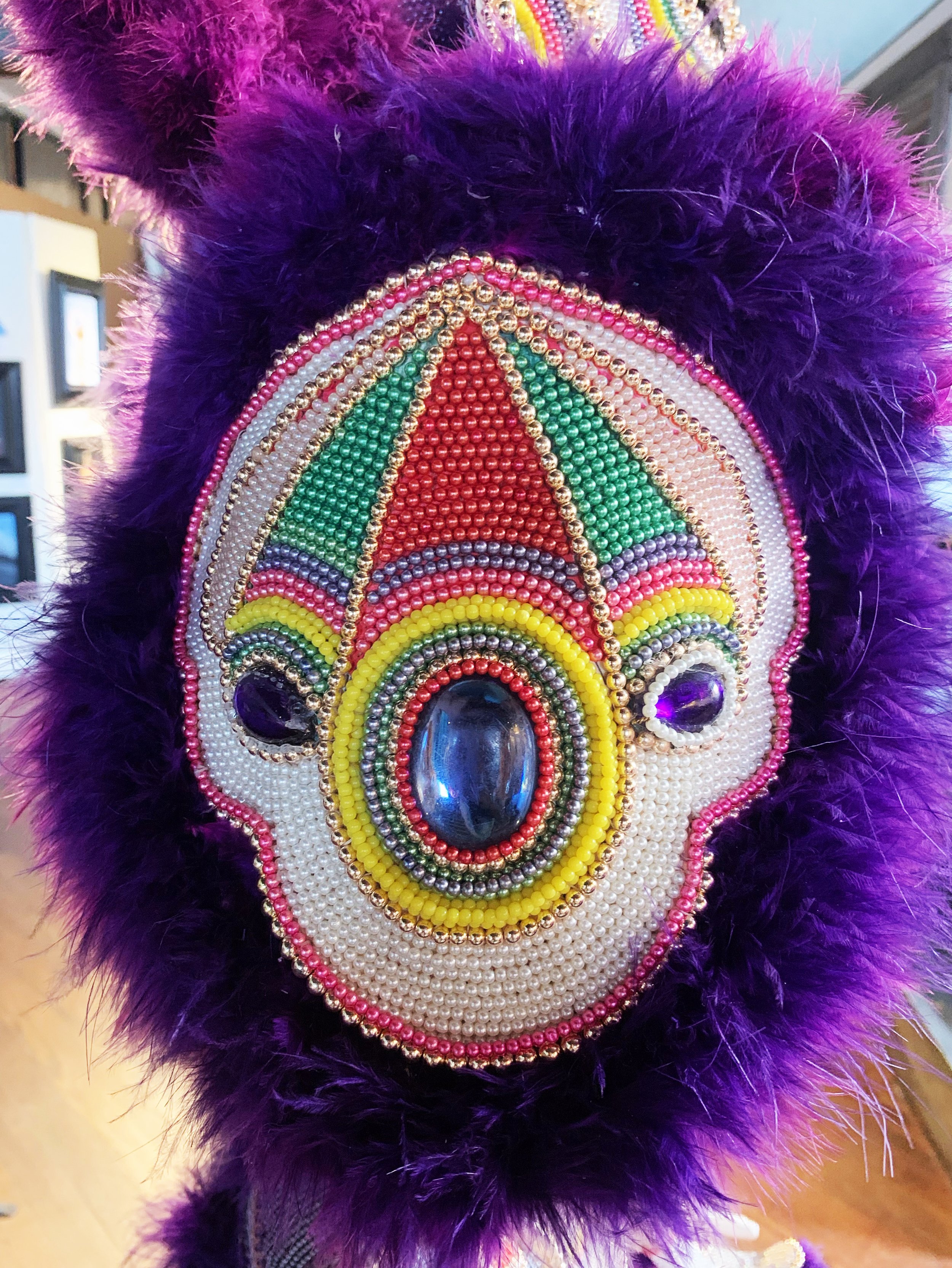
The Indigenous Masking tradition involves year-long creation processes, generational knowledge, and symbolic visual language. Suits incorporate hand-sewn beadwork, applied feathers, soft sculpture, and intricate patterning that transform the wearer into a layered narrative form. Chief Shaka’s suits operate conceptually, using their imagery as entry points into broader conversations about ecology, heritage, cosmology, and resilience within the African diaspora. His work positions the suit as a contemporary art object that can educate, inspire, and connect local cultural practice to global audiences.
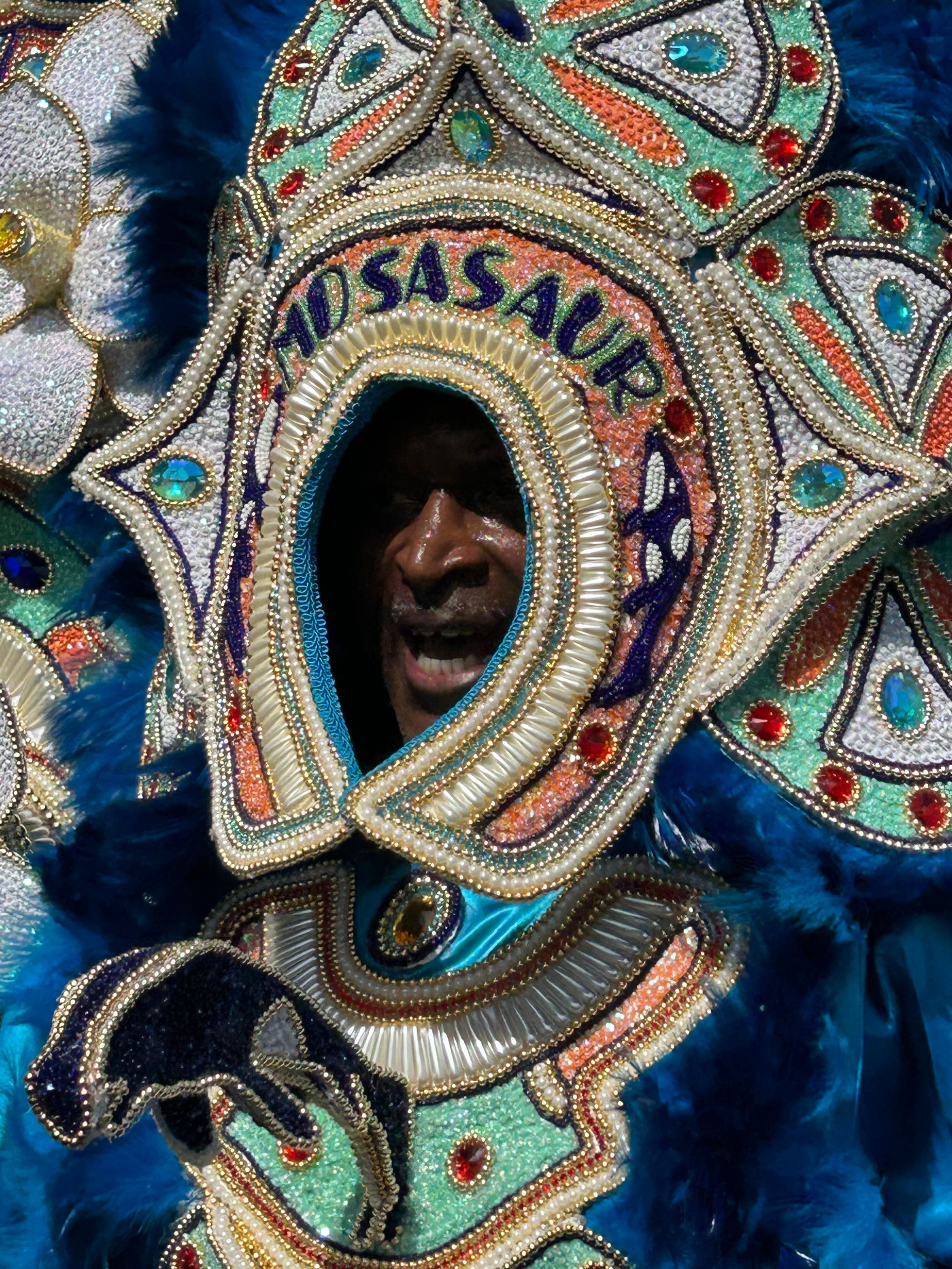
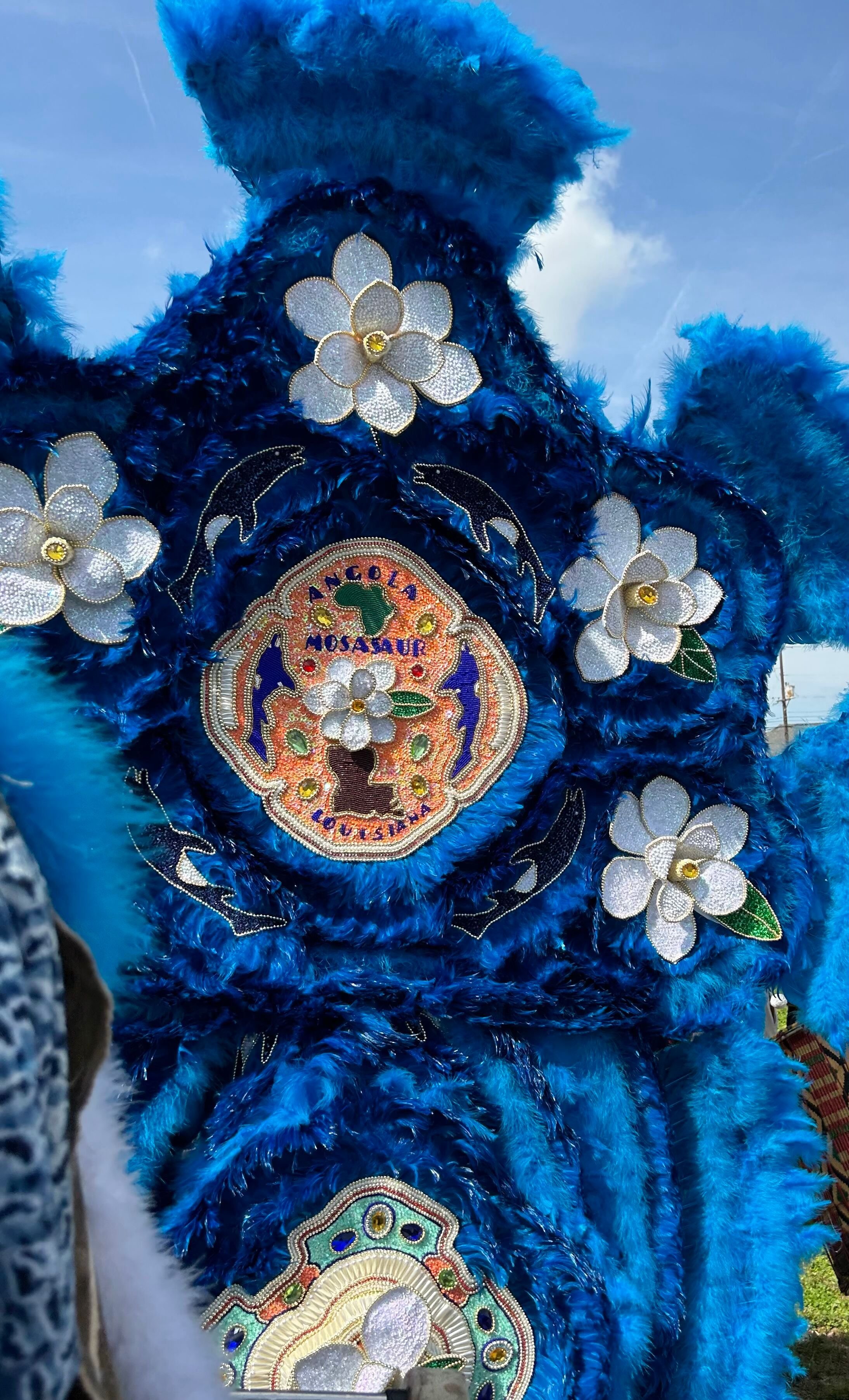
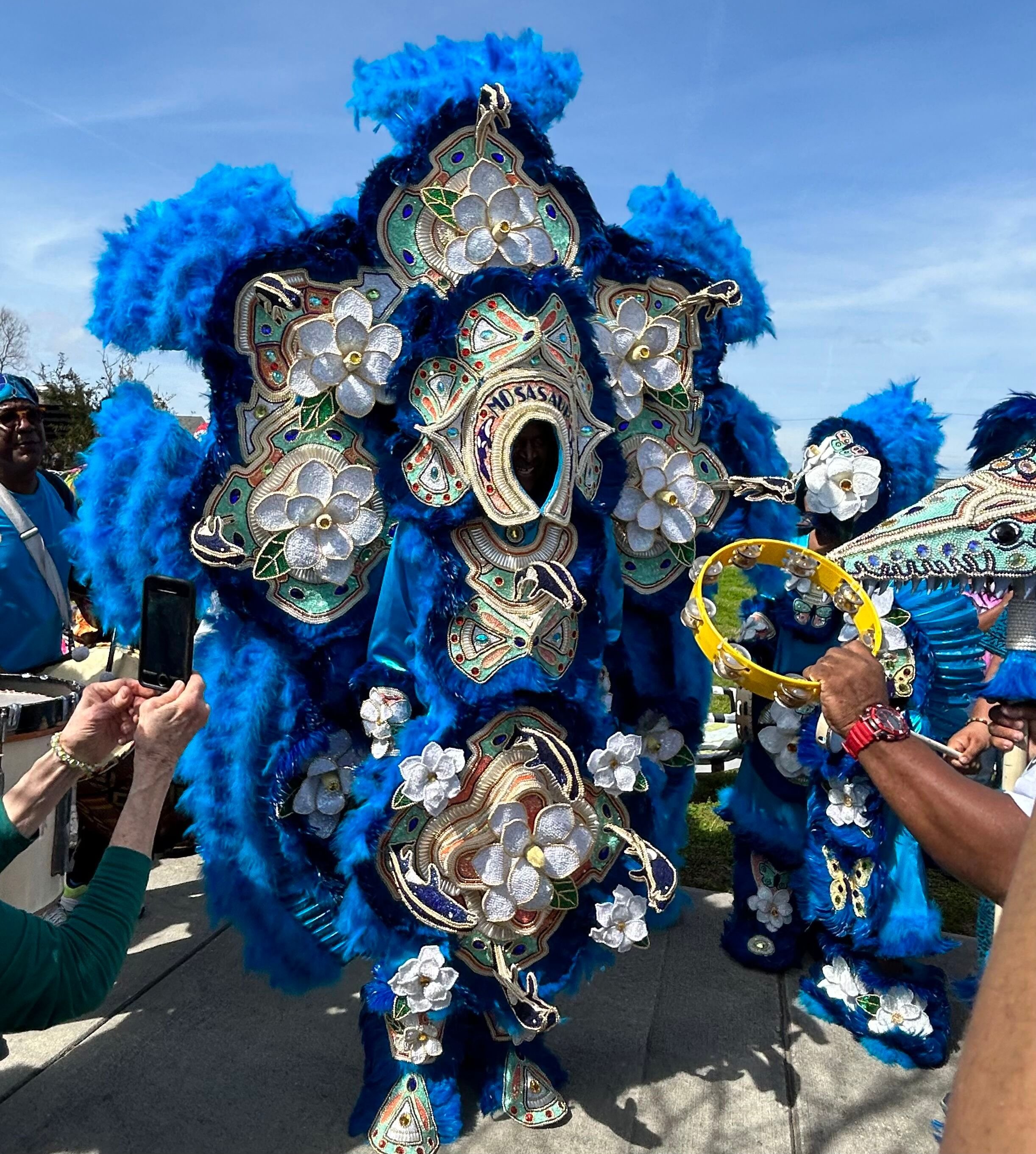
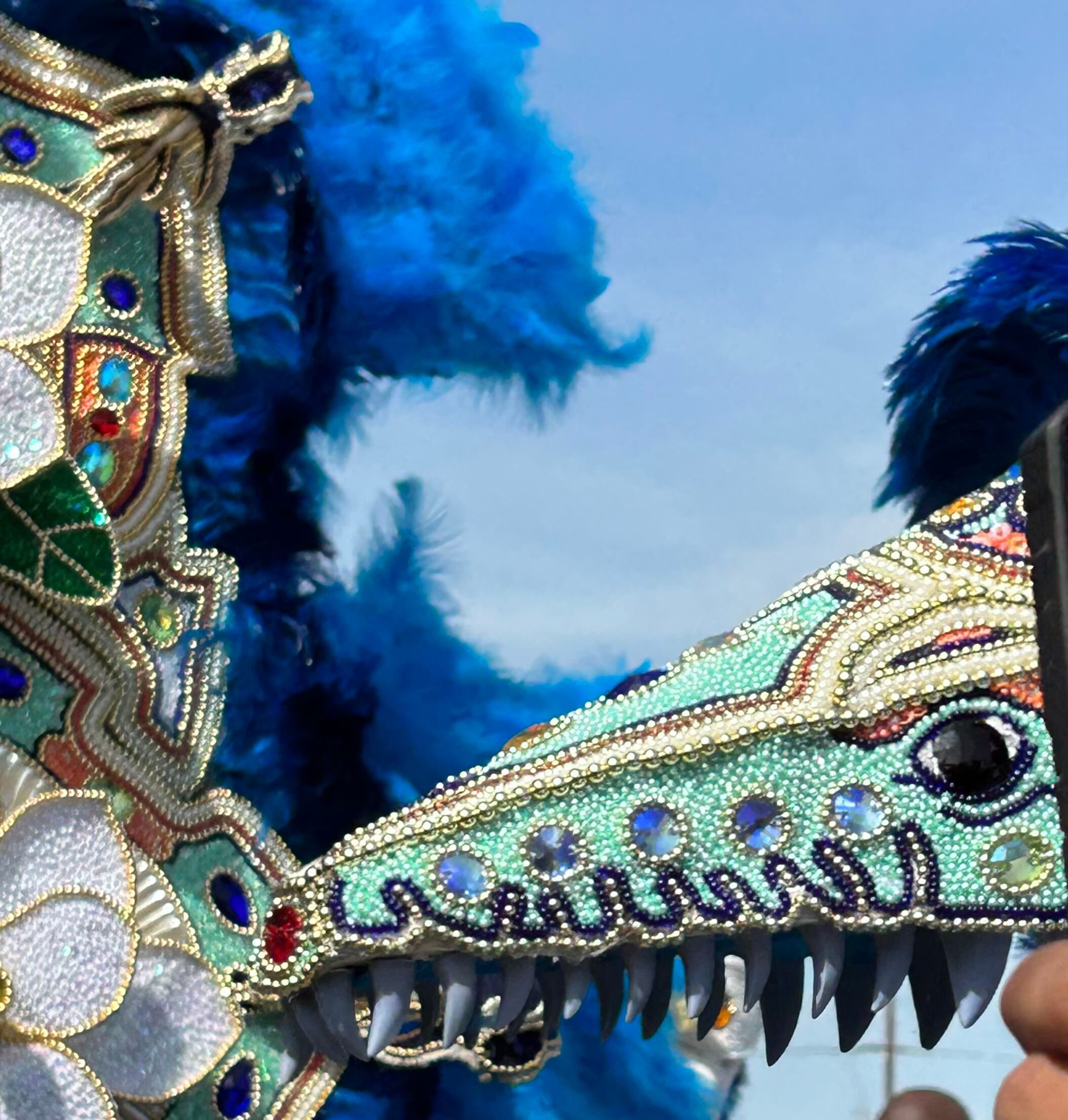
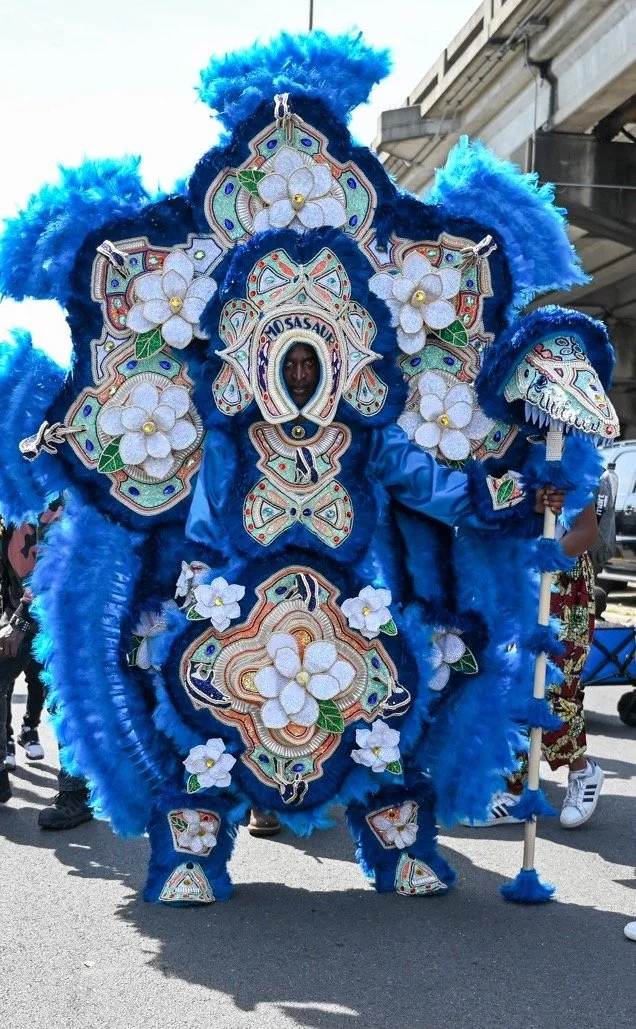
Blooming the Mosasaur - 2023
Big Chief Shaka represented the Mosasaur on his suit, "The Blooming of The Mosasaurs". The Mosasaur is a marine reptile found in Angola Africa and teeth were found in Louisiana. What an amazing prehistoric connection that Shaka brought together in this masterpiece.


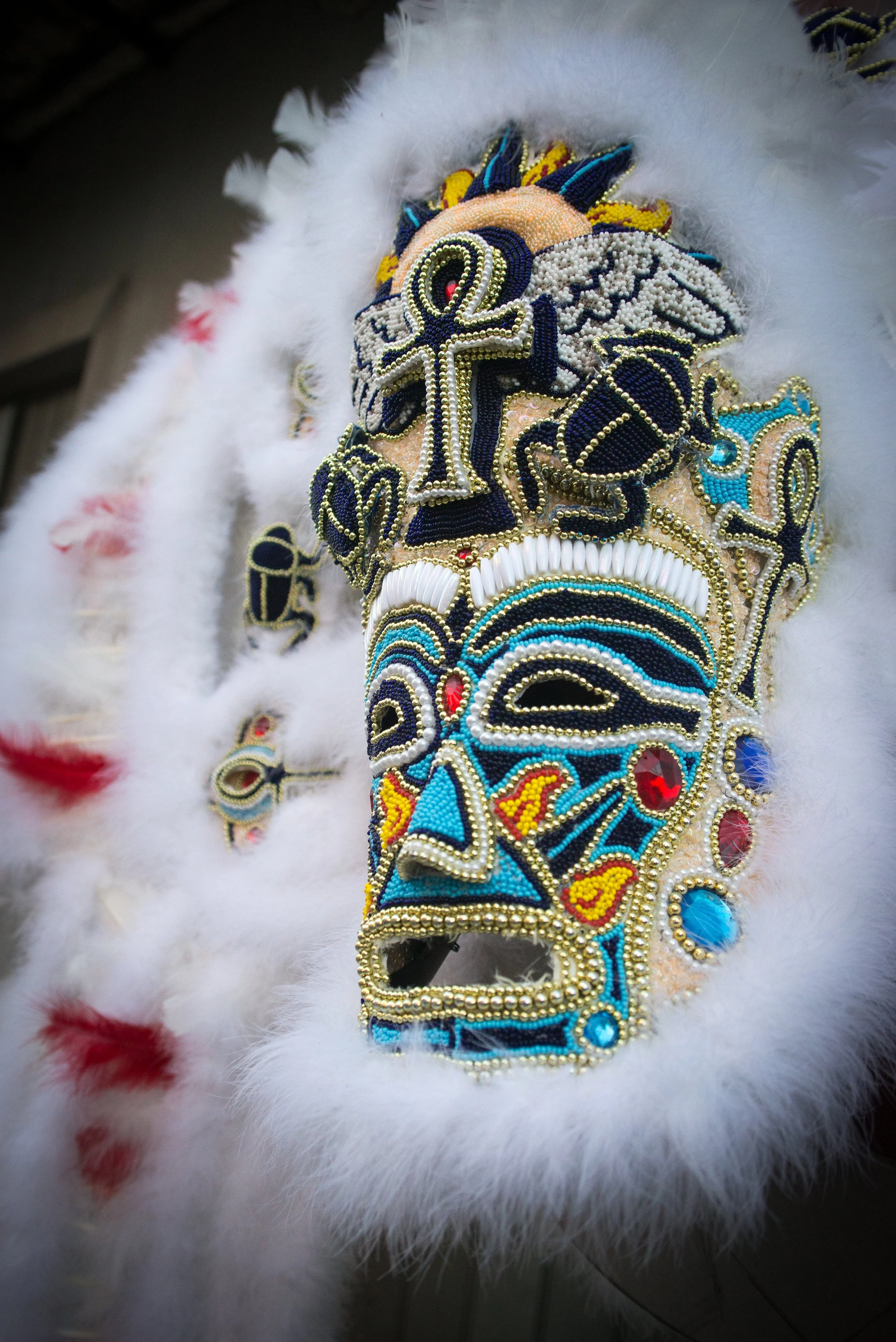
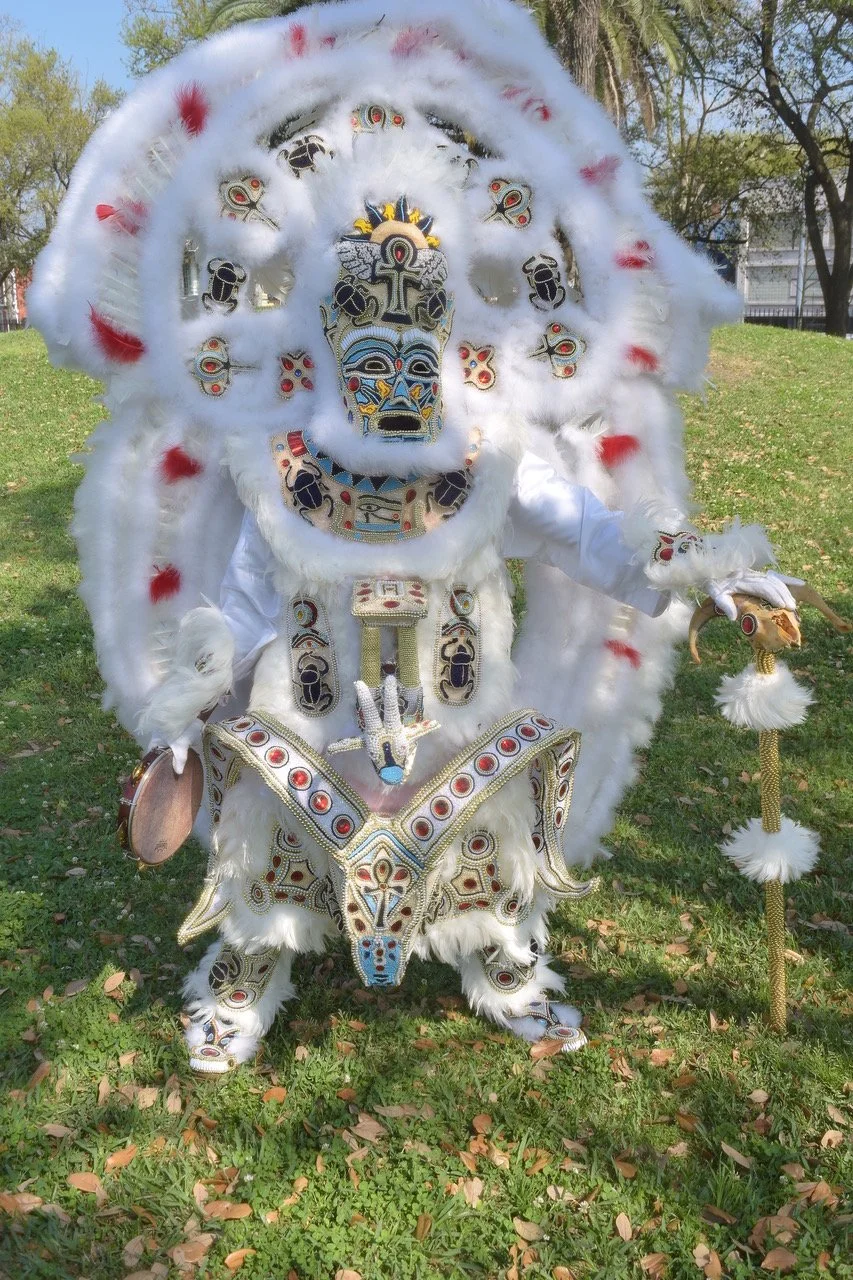
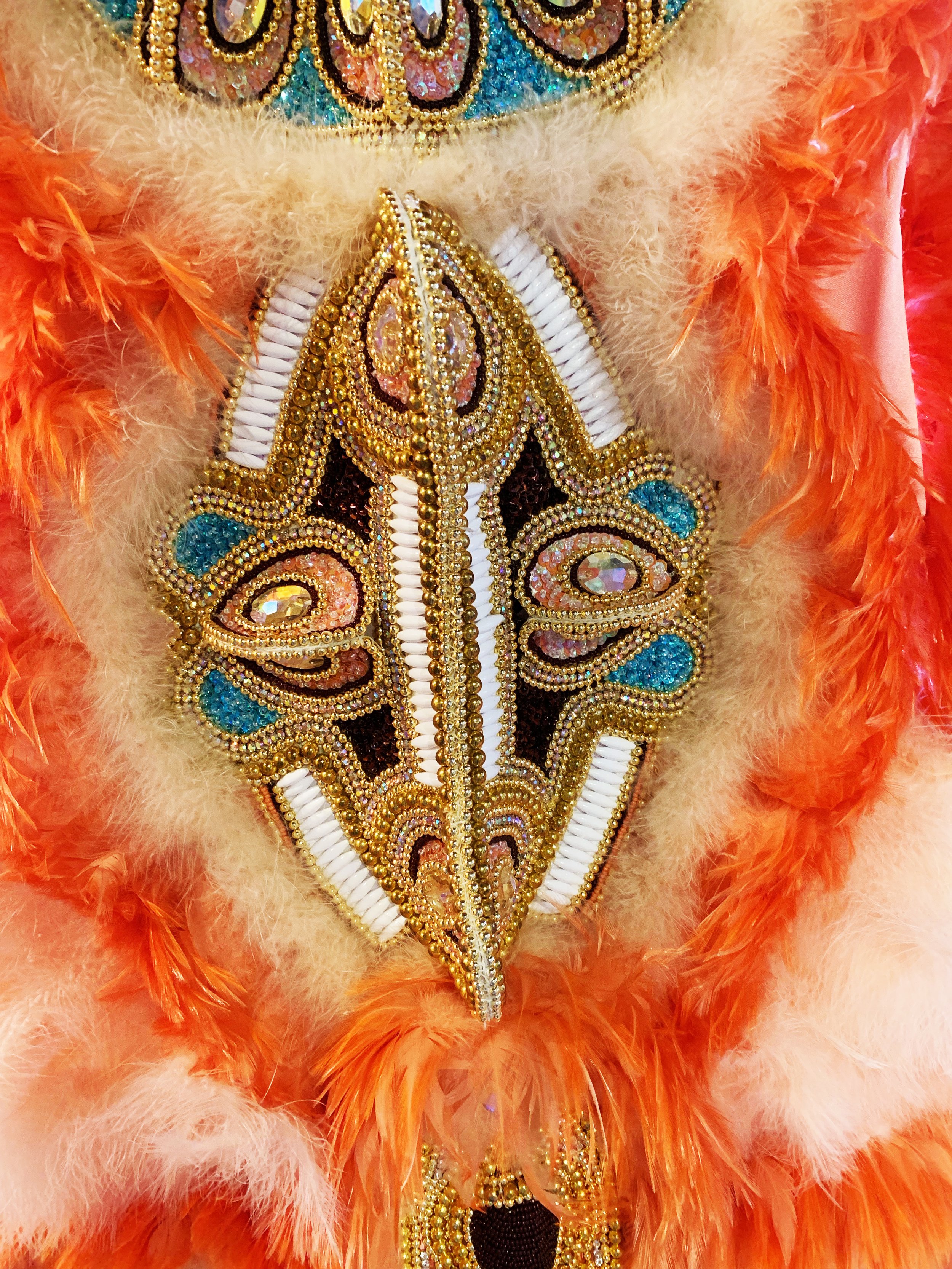
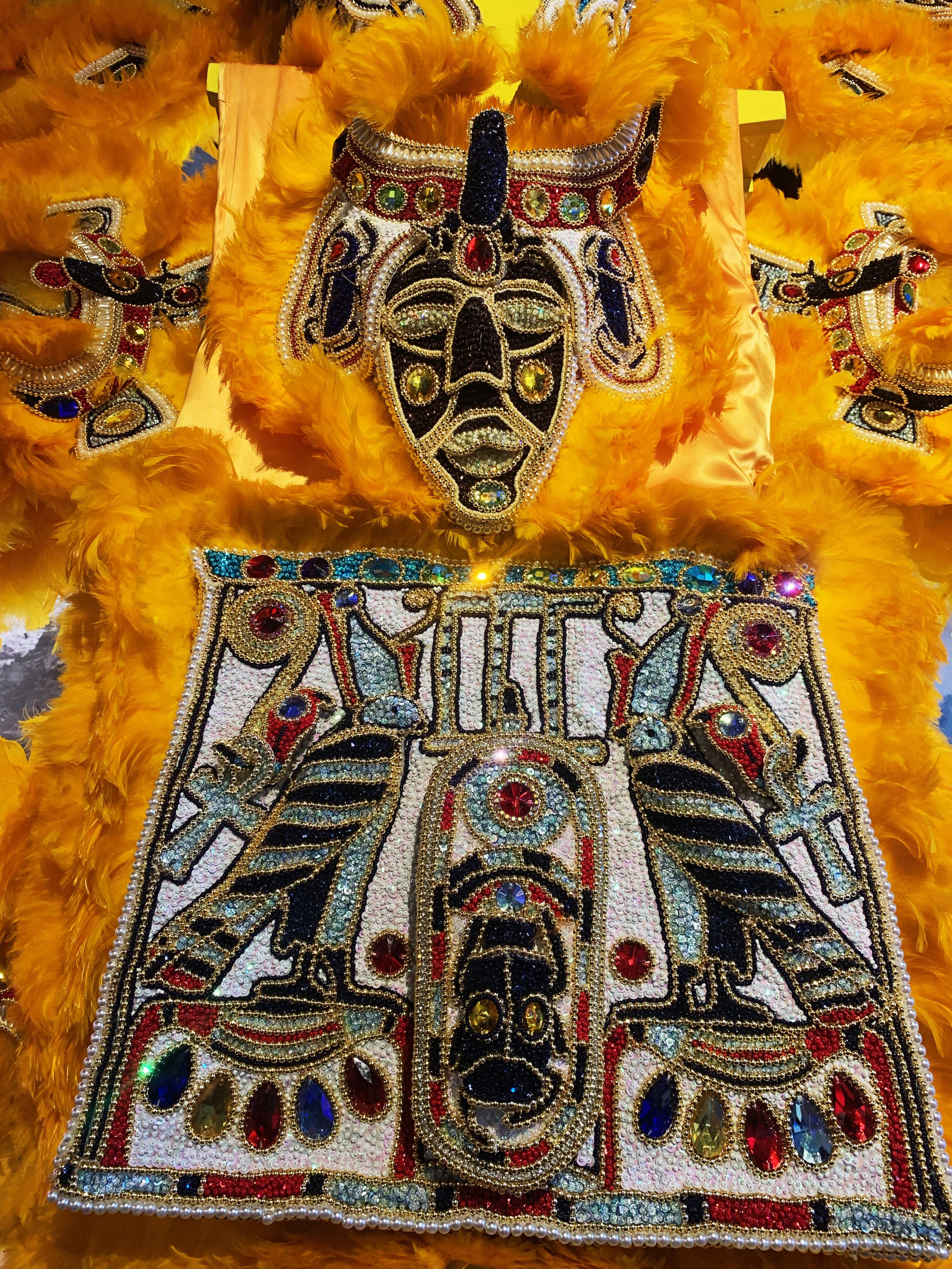
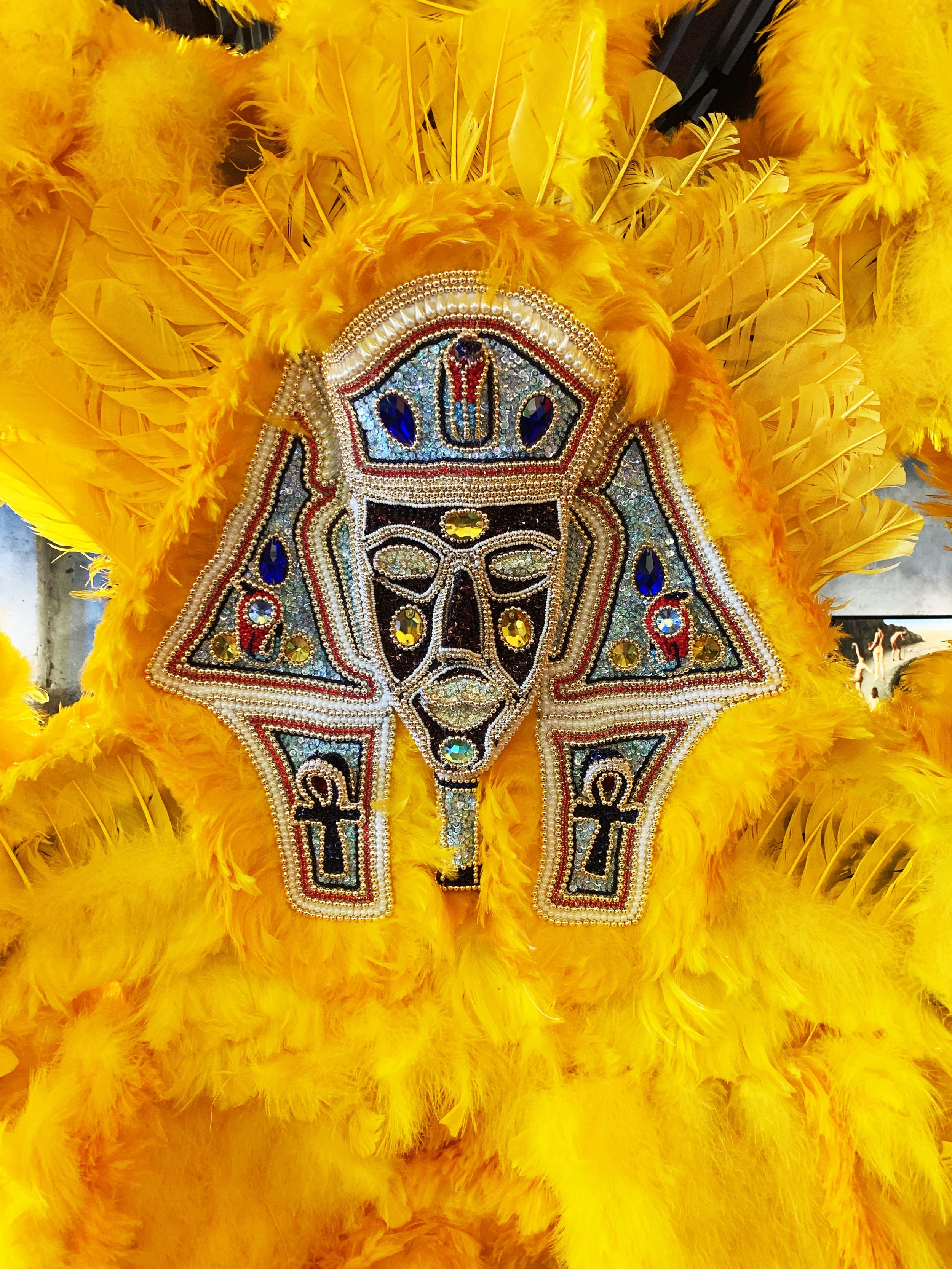
Self Begotten in Gold, Incorporates Egyptian cosmological motifs such as Heru and the ankh to explore themes of rebirth, luminosity, and ancestral continuity, linking ancient symbolic language to contemporary diasporic identity. 2022


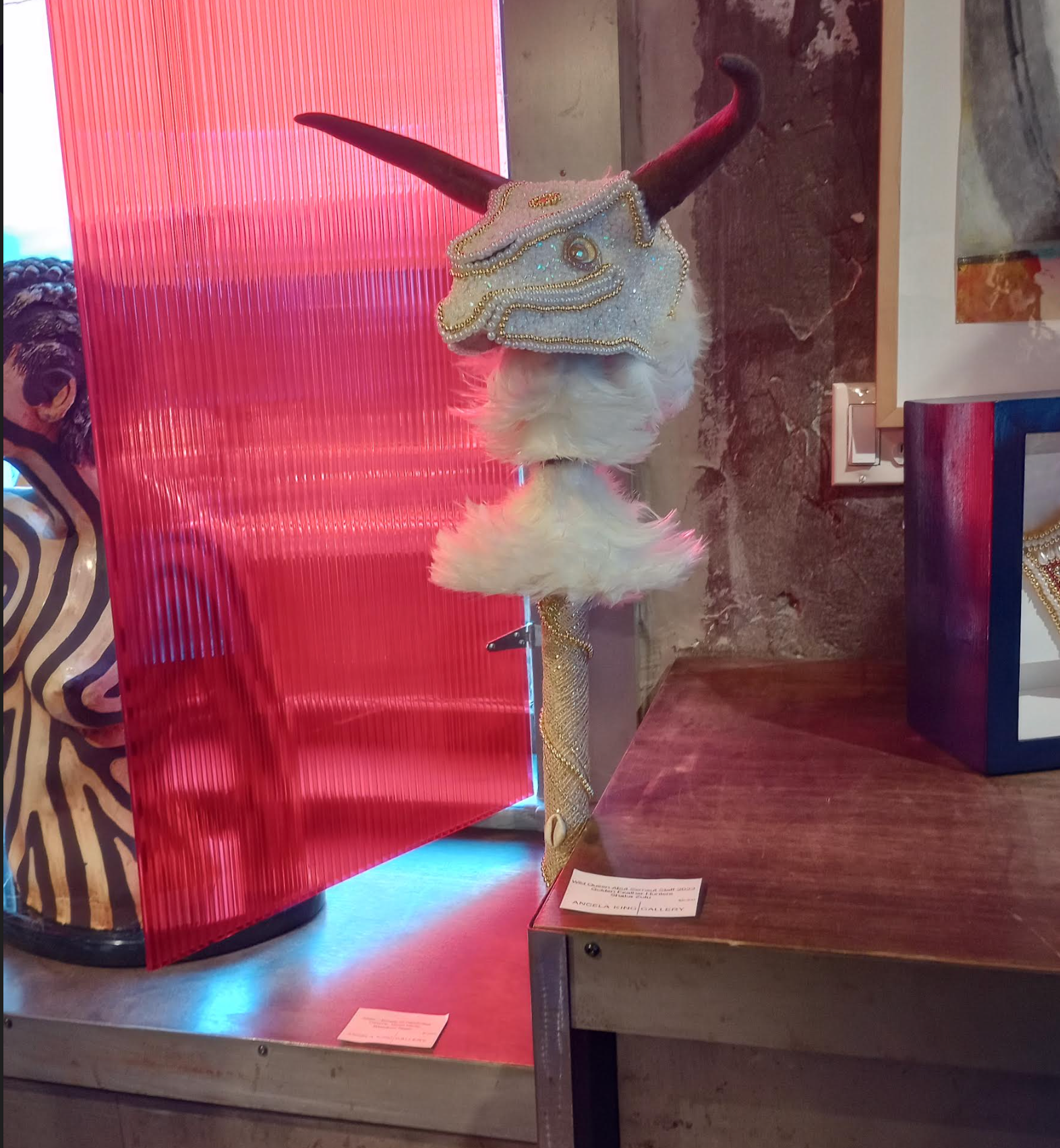
RED AND WHITE COLORED SUIT, VOLUME II OF THE RAM AND AXE THEME


SEAFOAM SUIT UTILIZING THE EGYPTIAN THEME


Coral colored suit in honor of the honey bees
This suit engages the honeybee as a symbol of ecological fragility and interdependence, drawing attention to collapsing pollinator populations and the environmental networks that sustain human life.

Inspired by the toucan’s vibrant presence, this suit gestures toward rainforest biodiversity, habitat disruption, and the cultural imagination tied to environmental preservation. This Suit was sewn with the assistance of the Wameru and Maasai youth in Tanzania, Africa.
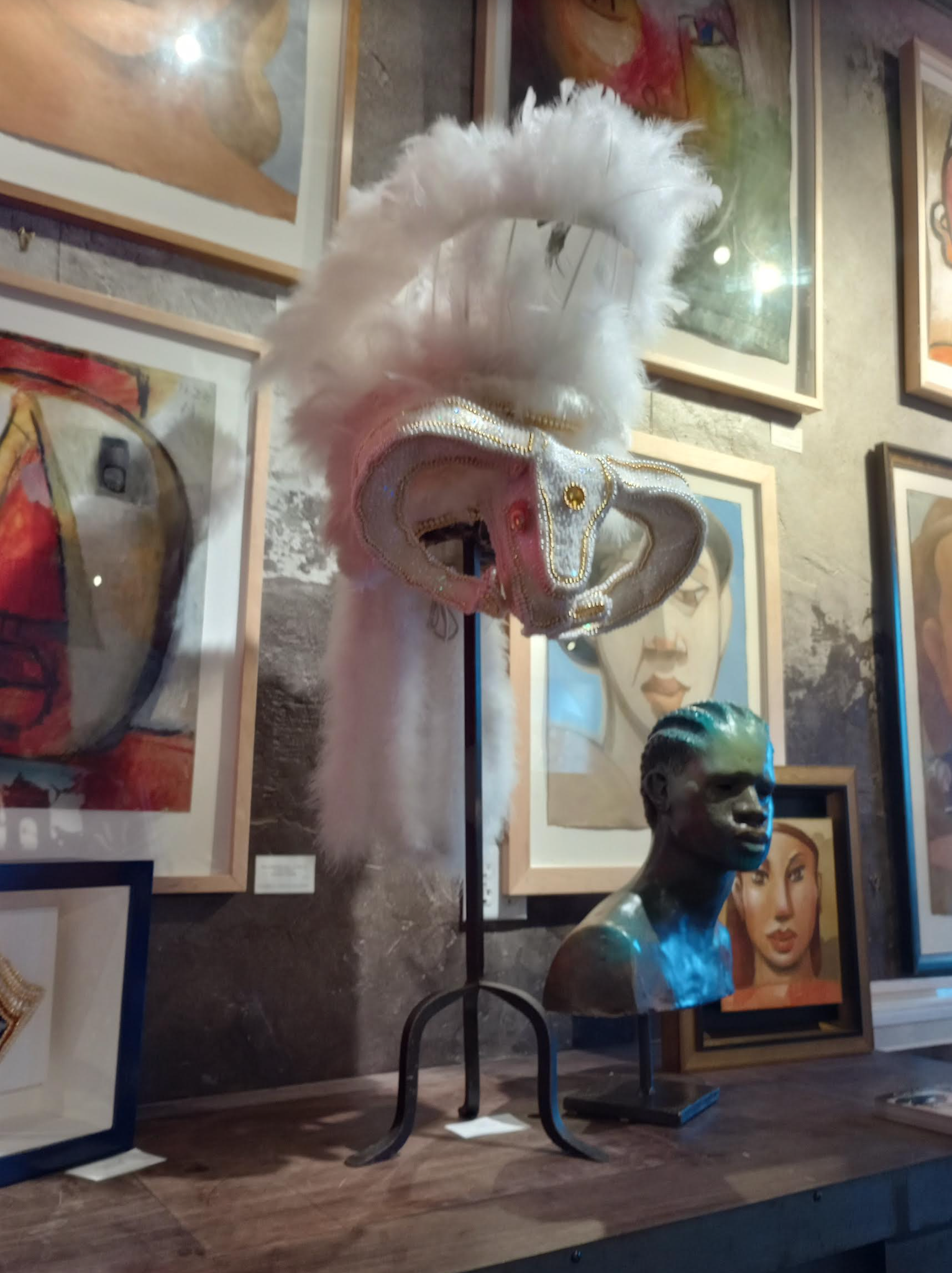
Detail & Install Shots





Artist in Action